Wednesday, October 4, 2017
Economics: Is OPEC Committing Suicide?
The losses would make sense if OPEC could sell oil much dearer in the future. Saudi Arabia & other OPEC members have still huge oil reserves in the ground and they have to plan - and to manage - their oil production over many decades to come. This reminds me of a discussion I had with my doctoral thesis adviser after OPEC`s oil embargo in the 1970s (to punish the West for Israel`s victory in the Yom Kippur War). We agreed that OPEC has to decide what to do with their oil reserves. There are two options: They can sell their oil today and invest the proceeds in their non-oil economy and other assets like stocks & bonds (Norway did that later and started their Government Pension Fund, known as Norway´s oil fund) or keep the oil in the ground and sell it later. The second option makes sense if the expected oil price gains (the interest rate on oil in the ground) are higher than the interest rate they could earn in the markets today.
Things have changed since then. Oil has an uncertain future. China, the world's largest auto market, is working on a plan to ban the production and sale of vehicles powered solely by fossil fuels. Bejing has already announced that any automaker producing or importing more than 30,000 cars in China must ensure 10 percent of them are all-electric, plug-in hybrid, or hydrogen-powered by 2019. That number will rise to 12 percent in 2020 (cnn bloomberg). Germany, France, UK and other countries want also get rid of fuel driven engines. So in some years the global demand for gasoline will shrink dramatically.
That´s bad for OPEC because crude oil is mainly used to produce gasoline. In some years the demand for gasoline will be replaced - at last to a large part - by demand for electricity. The chart below shows that in the US oil is already irrelevant as power source for electricity production: Just one percent of the US electricity comes from petroleum.
It´s similar with heating (chart below: source eia.gov/). Less than 20% of US households use oil for heating, the majority is heating with natural gas and electricity (produced mainly by coal & natural gas).
So, most of the oil - about 70% - is used for transportation and just around 30% for petrochemical products ( energy).
After 2020 oil prices could fall well below $20 thanks to the shrinking gasoline demand. Saudi Arabia and other big producers, who are sitting on huge oil reserves that should last many decades, would be well advised to sell their oil now. The current production cuts may hike the price of oil temporary - that will only heat up the trend to electric cars. It seems OPEC is causing her own death.
Saturday, September 30, 2017
Culture: Gojira @ Brooklyn Steel New York
(Drivebycuriosity) - I am a connoisseur of heavy metal. I really enjoy atmospheric rock music with very heavy riffs. Fortunately my wife shares this taste. This week we went to Brooklyn Steel in New York to watch a performance by Gojira.
This was the third gig by the French band we have seen. We had discovered them @ Chicago´s Open Air festival in
July 2016 where they played together with Rammstein, Deafheaven, Slipknot
and many other bands (driveby) and we observed another concert in New York in October 2016.
Originally the band had the name Godzilla, but it seems there were copy
right issues. Anyway, the original name fits well. Gojira´s music is
majestic & violent but beautiful. The French showed that they can
create heavy metal as well as the Scandinavian bands who seem to rule the
genre. This week they once again delivered massive walls of sound with
atmospheric & melodic elements.
Contrary to popular bands like Rammstein or Slipknot the French
refrain from relying upon show effects and focused on the music. Brothers Joe
Duplantier (vocals, guitars) & Mario Duplantier (drums) together
with guitarist Christian Andreu & bassist Jean-Michel Labadie mastered
their instruments virtuously and inspired masses in front of the stage
to crowd surf and mosh (jumping up and down and deliberately
colliding with other dancers).
I enjoyed the dramaturgy of the concert. Over the about 90 minutes of their show they increased intensity, mixing melodic & atmospheric parts with explosive elements. When I thought they had reached their climax an even higher peak followed. Stroboscopic lights and laser beams enhanced the psychedelic impression.
Thank you so much Gojira for this experience. Some day we might see you again.
Friday, September 29, 2017
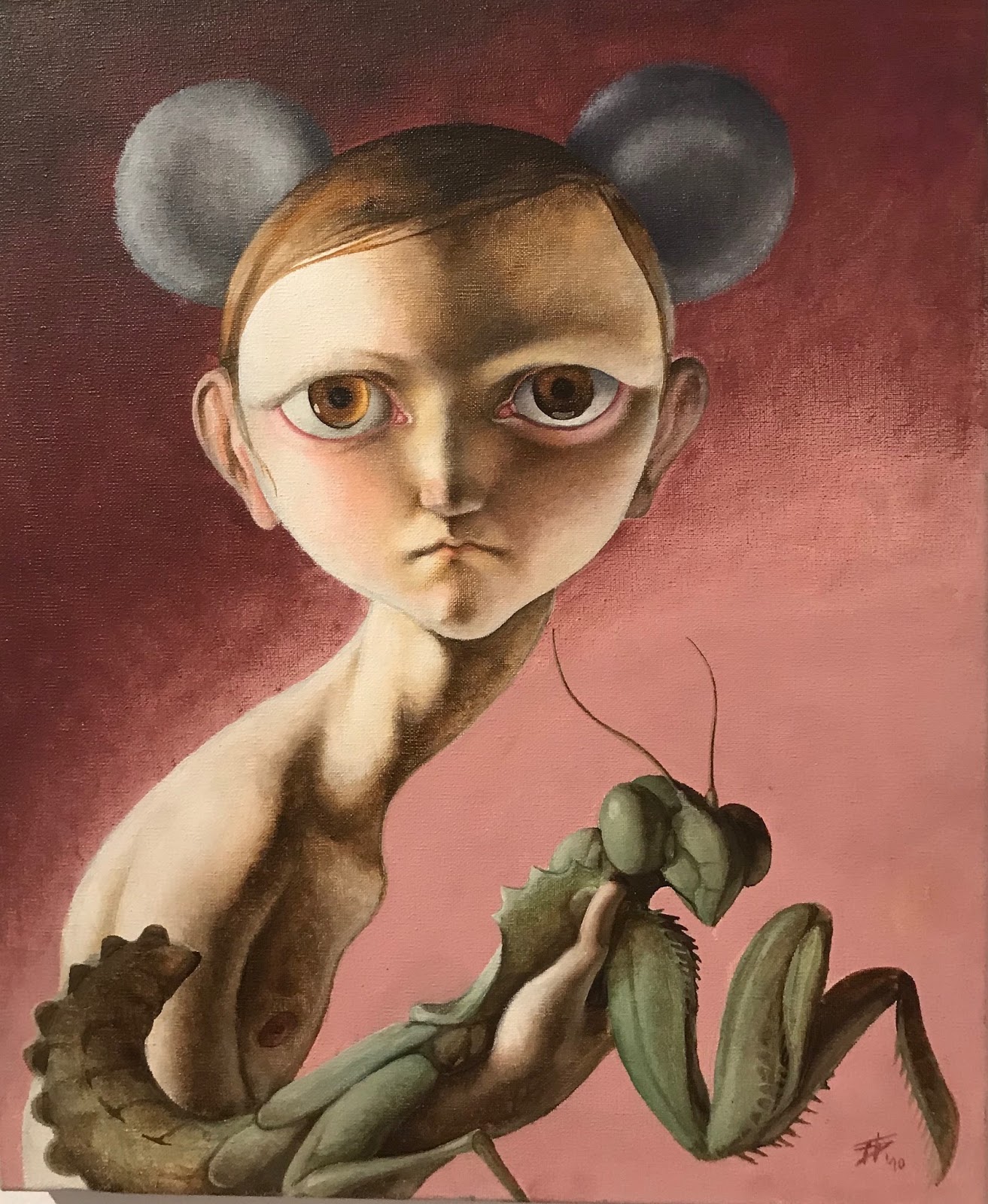
Contemporary Art: Have Fun With Dani Torrent
I like the artist`s surrealist style and his humor. The images are a bit spooky but also funny. These works remind me of the paintings by John Currin (thebroad) but also of the works by Margaret Keane who got portrayed in the movie "Big Eyes" (imdb). But Torrent certainly found his own unique style.
To be continued
Wednesday, September 27, 2017
Economics: Why Secession Begets Success Stories
Secession isn`t a new idea. In the early 1990th many regions used the breakdown of the defunct Soviet Union to gain freedom and to become independent states: The Baltic states (Estonia, Latvia, Lithuania) plus Ukraine, Azerbaijan, Uzbekistan, Moldova and more. At least some of the them have flourishing economies now. Today the Baltic states Estonia, Latvia, Lithuania all have higher per capita income then the Russian Federation (worldbank). Other parts of the former Soviet empire also broke apart: Yugoslavia (into the separate states Serbia, Croatia, Bosnia & Herzegovina, Montenegro, Macedonia & Slovenia) and Czechoslovakia (into Czech Republic & Slovakia). There is global trend toward having more and smaller countries: In the mid-1950s, there were 80 states in the world. Today, there are 200 (ibtimes).
History shows that even very small countries can prosper after becoming independent. Switzerland has been proving for many centuries that small states can do well. 1499 the country separated from the German federation, the Holy Roman Empire. Switzerland didn´t participate in World War I, neither in World War II and decided against a membership of the European Union. In 2016 Switzerland had a per capita income of $78,000 beating neighbors Germany ($41,000) & France ($36,000 ) and even the USA ($57,000 ) by far ( worldbank). The tiny independent states Luxembourg & Liechtenstein also belong to the richest nations of the world.
There are more success stories. Taiwan separated in 1949 from Motherland China which led to a "period of rapid economic growth and industrialization, creating a stable industrial economy" (wikipedia). Today Taiwan has a per capita income of $39,600, about 5-times of China ($8,100). Hong Kong, which got separated in the 19th century, has a per capita income of $43,600. Singapore did even better. The tiny state had been a part of Malaysia, but got kicked out in 1965 after political conflicts (wikipedia). The independence brought Singapore swift economic growth, thanks to the intense trade relationships with the rest of the world. Today Singapore has a per capita income of $52,000, far above Malaysia ($9,500) and Indonesia ($3,500).
This is no coincidence. Small countries (and independent regions) are less complicated than huge states. They are easier to govern and to manage and therefore they are less bureaucratic. The government of a small country is closer to their citizen and can respond better to local needs. Government decisions about taxes, health car, public spending and more could be fairer & more efficient.
Creative Environment
Secession leads to decentralization. Decentralization "increases efficiency - and effectiveness - due to reduction of congestion in communications, quicker reaction to unanticipated problems, improved ability to deliver of services, improved information about local conditions, and more support from beneficiaries of programs" (wikipedia).
Europe became the world’s most dynamic civilization after around the year 1500 partly because of political fragmentation and competition between multiple independent states, wrote the historian Niall Ferguson (bostonglobe). Small countries like The Netherlands became global power and stayed wealthy till today. The Italian Renaissance happened as Italy was just a cluster of small independent city states like Milan, Florence, Pisa, Siena, Genoa, Ferrara, Mantua, Verona and Venice. The competition between these places created an creative environment that inspired advances in arts, science and business (wikipedia). The independent Greek city states (Athen, Byzantium, Sparta, Troy and more) developed democracy and founded European culture. The huge Roman Empire instead, which spread from Northern Africa to Southern England, broke down under its own weight. Today Switzerland & Norway aren`t member of the European Community - and both countries are doing well. People worldwide are buying Swiss products & services and don´t care whether the country is part of an union or not.
I believe that Catalonia and Kurdistan each can repeat these success stories by focusing on their human capital and trading freely with the rest of the world as Switzerland & Singapore do.
I believe that small countries (and separate regions) have just one disadvantage: They are military weak and could be easily overrun by enemies. But the existence of Switzerland, Singapore, Luxembourg, Andorra and other tiny states shows that this risk is very low today. It is not likely that Catalonia will be attacked by its neighbors Spain & France.
Viva la independence.
Monday, September 25, 2017
Contemporary Art: New Collages & Abstracts @ Gallery Artifact New York
(Drivebycuriosity) - I like contemporary art. Therefore I am often
visiting art galleries in my neighborhood, New York`s Lower East Side.
Gallery Artifact (84 Orchard Street artifactnyc) belongs to my favorite places, because the art trader has frequently changing art shows which are usually amazing.
At my recent visit I discovered some new & interesting art works. I show here my favorites, a very subjective selection as usual. Above and below you can see collages by Susie Mckay Krieser (susiemckaykrieser). I fancy the combinations of photos and colorful paintings.
Surrealist Abstracts
I also enjoyed the surrealist & powerful abstracts by Erica Fromme (erica-fromme).
To be continued.
Thursday, September 21, 2017
Culture: SubRosa & Wovenhand @ Saint Vitus Brooklyn
(Drivebycuriosity) - I am a connoisseur of heavy metal. I really enjoy atmospheric rock music
with very heavy riffs. Fortunately my wife shares this taste. Yesterday we
went week to Saint Vitus Bar, a tiny place in Brooklyn, practically a hole in the wall. 2 bands played there which we had enjoyed before.
We saw SubRosa @ Psycho Las Vegas this August. The quintet (Rebecca Vernon: Guitar, vocals, Sarah Pendleton: Electric violin, vocals, Kim Pack: Electric violin, vocals, Levi Hanna: Bass & Andy Patterson:
Drums) call themselves an experimental sludge-doom metal band. I was fascinated then by the combination of very heavy metal riffs with fierce attacks by the two violins and the voice of Rebecca - an unique experience.
Unfortunately we missed one of the female violin players yesterday, which reduced the sound experience somewhat. Maybe the tiny stage was too small for so many people (their website shows still 5 members subrosa). But anyway - the gig was an experience I want to repeat sometime. And I am grateful to the band who took the effort to squeeze themselves and their equipment through the densely packed audience (there was no back stage).
Metal Opera
Wovenhand delivered a very different show. We had seen the band @ Madrid`s Kriston Fest last May, which focused on stoner metal. This time Wovenhand was much more aggressive and heavy. Their sound changed from balladesque to gothic & psychedelic - a real gain. Frontman David Eugene Edwards has a strong voice, which reminded me a bit of Danzig singer Glenn Danzig. David, who is known as a devout christian, seemed to celebrate a Holy Mass. Even though I am an agnostic I was mesmerized by David´s powerful gospels which were enhanced by the massive riffs of the band - a kind of metal opera.
The concert was a strong experience, but I feel sorry for these outstanding bands, who perform in such mediocre venues.
Tuesday, September 19, 2017
Street Art New York: Best Of Summer 2017
I discovered the girl photographing the blurred Mickey Mouse on Crosby Street between East Houston and First Street, a place where frequently amazing murals appear.
The "no parking face" beautifies a door in the East Village.
The legs above walk @ corner of Stanton & Christie Street on the Lower East Side.
I found this beautiful lady between East Houston & First Street. There is an area used by New York`s Centre-Fuge Public Art Project, a collective of street artists who show there their own works and murals by invited participants.
I caught these artists working @ the corner of Elizabeth Street & East Houston. This fashion shop sponsors frequently changing art work of high quality.
Same Spirit
Some artists focused on cats. I saw the tiger on Lafayette and the lion looks onto Allen Street.
Above a mail collecting box on Suffolk & Stanton Street.
This work of anonymous art maybe not really street art. I spotted the sketch of a girl carved into a seat in the subway (D Train). But it shows the same spirit.
To be continued.