Saturday, January 19, 2019

Contemporary Art: Epic Abstraction @ Metropolitan Museum Of Art New York


(Drivebycuriosity) - New York`s Metropolitan Museum of Art is always worth a visit. The huge museum has a vast collection of art works and offers a lot temporary exhibitions. This week my wife and I took a look into their show " Epic Abstraction". They display icons of abstract art, which revolutionized the art world and are still influencing many artists (metmuseum). Some of them are really huge and impressive.

I love the "trip paintings" by Jackson Pollock. They look still wild & chaotic, maybe they are representing the Big Bang?

Above you can see his "PasiphaĆ«" from 1943 (Oil on canvas; 56-1/8 x 96 x 1-1/2 in. (142.6 x 243.8 x 3.8 cm). The curators explain Pollock"developed this novel interpretation of the Surrealist technique of automatism (which taps the artist’s unconscious to compose the image) by creating dozens of colored drawings, a selection of which is on view nearby. Amid the chaos are barely discernible sentinel-like forms on both sides of a prostrate figure in the center. Pollock originally called this painting Moby Dick, but he retitled it after hearing the story of the Cretan princess PasiphaĆ«, who gave birth to the half-man, half-bull Minotaur."


Above  Pollock`s "Number 7" created 1952 (Enamel and oil on canvas; 53 1/4 x 40 in. (134.9 x 101.6 cm)


Pollock`s majestic "Autumn Rhythm (Number 30)" from 1950 (Enamel on canvas; 105 x 207 in. (266.7 x 525.8 cm) .


Above Pollock`s "Number 28, 1950" (Enamel on canvas, 68-1/8 x 105 x 1-1/2 in. (173 x 266.7 x 3.8 cm).


                                               Invitation To Meditate


Mark Rothko`s paintings are an invitation to meditate. Above his  "No. 13 (White, Red on Yellow)" from 1958  (Oil and acrylic with powdered pigments on canvas; 95-1/4 × 81-3/8 x 1-3/8 in. (241.9 × 206.7 x 3.5 cm).


The woman above is enjoying "La Vie en Rose" by Joan Mitchell from 1979 ( Oil on canvas) .


This woman is admiring “1950-E” by Clyfford Still from 1950 ( Oil on canvas; 91 1/4 x 69 in. (231.8 x 175.3 cm).


Above "Easter Monday" by Willem de Kooning created 1955–56 (Oil and newspaper transfer on canvas; 96 x 74 in. (243.8 x 188 cm).


Above the impressive "Duck Walk" by Mark Bradford from 2016 (Mixed media on canvas; 9 ft. 1/4 in. × 14 ft. 1/2 in. (275 × 428 cm).


Above “Night Journey” by Frank Bowling created 1969–70 (Acrylic on canvas;  H. 83 3/4 x W. 72 1/8 in. (212.7 x 183.2 cm).


Above "New York #2" by  Hedda Sterne from  1953
( Oil on canvas;  :78 × 34-1/8 x 1 in. (198.1 × 86.7 x 2.5 cm).


This woman is looking on "Dutch Interior" by Cy Twombly, created 1962 (Wax crayon, lead pencil, oil on canvas; 8 ft. 9 1/8 in. × 9 ft. 10 7/8 in. × 1 3/16 in. (267 × 302 × 3 cm).

To be continued


Thursday, January 17, 2019

Traveling: Impressions From Aruba - Sand, Water & Coconut Palms

(Drivebycuriosity) - My wife and I are just back from Aruba, where we stayed 7 nights. Aruba is a small island in the Caribbean Sea close to the coast of Venezuela. Like the sister island Curacao (which we visited last year, here my report ), the island is a former Dutch colony. Today both islands are independent countries but still connected with the Netherlands, which supports them financially. Therefore Aruba & Curacao are more European & wealthier than other Caribbean islands.


There is not much to do.  Staying there means enjoying sand, water & coconut palms. The island has a big advantage: The superb weather. Like Curacao - and the Colombian beach town Cartagena (we stayed there in 2017) the island has almost a desert climate, resembling Southern California. Temperatures hovered close to 80 F (26 C) and there was no rain and few clouds. The humidity is low which separates these places from the typically humid Caribbean islands. As a result there is no tropical lush vegetation,  but the hotels planted myriads of coconut palms and other plants along the beach.


We stayed at Palm Beach, a long stripe of very white & smooth sand, where you could walk miles south or north. There is no surf and the water is very shallow. Even after walking about 30 feet into the water I could still stand on a muddy ground covered with grass. Because of the shallowness the waves are stirring up the ground and the water looks milky and is almost opaque. Even though I swam and dove with goggles I didn`t spot any fish there - disappointing - and not many frigatebirds, sea gulls and other birds who live from fishing. But the beach had some stray dogs.

There was a rope along the beach which separates the swimming region from the outer area which was used by speed boats and such. It looked a bit like a highway. 


Palm Beach is flanked by dozens of hotels stretching from budget place to upmarket locations including Marriott & Ritz Carlton. These tourist factories accommodate masses of guests.


The dry climate and a mostly cloudless sky allows spotting gorgeous sunsets.


I enjoyed how the colors changed after sunset .

Unfortunately the beach was very crowded and the shady huts - which we could rent for about $60 a day - stood side by side. But I got somewhat compensated by nice views.


There were a lot beach bars of course.

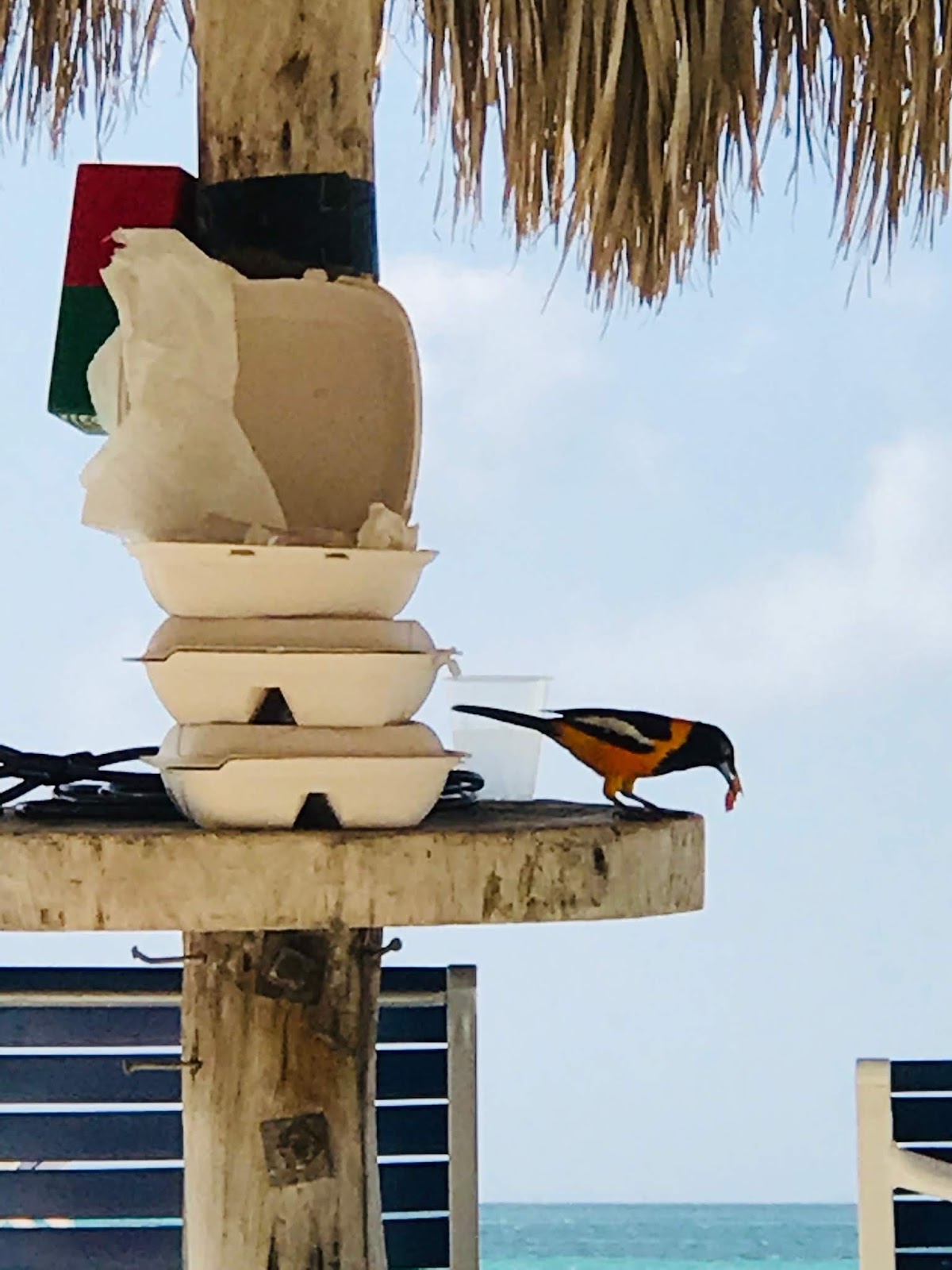
The lack of seabirds got somewhat compensated by the funny & colorful troupias - also the national birds of Venezuela - who where preying on the fast food rests or where attracted by the bar. Alcoholism everywhere.


                                                      Legal Immigrants 


The hotel has also a pool with iguanas & turtles plus some legal immigrants: Myriads of Japanese Kois & two Australian black swans.


The beach area has also myriads of restaurants catering the masses. We found 2 fine places: Elements Restaurant at Bucuti & Tara Beach Resort and Atardi, which belongs to Marriott. Both are on the beach and Atardi puts the tables onto the sand. A very romantic place with excellent food, but prices like in Manhattan.


Our Aruba vacation was fun and a nice escape from New York`s winter weather.


Monday, January 14, 2019

Economy: Why A Nearby Recession Is Highly Unlikely

(Drivebycuriosity) -  There is a lot talk about a nearby recession. The usual high priests of doom & gloom are calling a recession for 2020 or even for this year. I think the recession callers will get wronged as they did in 2015 & 2016 (driveby). I will describe below why a recession is highly unlikely this or next year.

The global economy is getting a lot tailwinds from cheap commodities including copper, steel & aluminium. The  price of oil (Brent Crude) dropped about 30% since last autumn. Oil costs about 15% less than a year ago which translates into cheaper gasoline. Today Americans pay about 12% less at the gas pump than last year. Consumers have more money in their wallets to spend for other goods & services - which is boosting consumer spending - and companies have lower costs. 

Former recessions were often caused by spiking oil prices. In 200/08 the price of oil tripled and jumped to $146. According to Prof. James D. Hamilton, University of California, San Diego the oil price spike turned the economic slowdown into a severe recession (econbrowser). Today the price of oil hovers around $60 - far below the danger zone. In 2011 & 2012 the global oil price (represented by Brent Crude) floated around $120 without causing a recession in the USA (brent-crude). So, the price of oil has to rally more than 100% to become a serious thread to the economy. The recent sharp drop of oil prices and Opec`s problems to hike the oil price again, thanks to the climbing US production and fracking, reduce the risk of an oil price induced recession considerably. Rising oil prices also would encourage more oil pumping and would extend the current oil glut.


macrotrends )


Since World War II recessions were also often caused by the Federal Reserve who responded too late to rising inflation rates (wikipedia). Then the Fed needed sharp interest rate hikes to break the inflation mentality. This risk is also very low. The Fed already hiked her interest rates 9-times and there a no signs of an accelerating inflation. In December the US inflation rate (consumer prices) dropped to 1.9%. The so-called core inflation rate (with oil & food) was 2.2% (calculatedrisk). Inflation rates will stay constrained because oil prices are getting tamed by the rising US oil production. Other prices are curbed by the Internet, automation & other aspects of the technological progress which are reducing the costs of producing & distributing stuff and therefore curb inflation (Amazon effect).

We are also far away from an overheating economy which could lead to over-investment. The US economy is grinding along with a slow but sustainable speed and grew about 2.8% in the fourth quarter according to the Federal Reserve Bank of Atlanta (frbatlanta ). There is no bubble which has to pop. Banks are solid as their climbing profits demonstrate. Yes, there are signs of a labor shortage, but this is partly compensated by automation.
 
And there is another tailwind: US companies are still benefiting from the tax reform & ongoing deregulation. Both changes are encouraging them to invest more. I think that a combination of cheap commodities, strong consumer spending, relatively low interest rates, regulation & taxes will keep the economic expansion alive for a long time.

BTW Economic expansions don´t die of old age! Last summer Australia’s economy entered its 27th year without a recession (reuters ). The Australians broke a record, which was hold by The Netherlands, which didn`t have a recession between 1982 and 2008. I don´t see a reason why the US should be unable to follow these examples.