Wednesday, March 12, 2014

Culture: Logan Hicks - Love Never Saved Anything, At Gallery Louis Zuflacht, New York City


(Drivebycuriosity) - It seems that Manhattan`s Lower East Side is stuffed with art galleries. There is so much to discover.


This week a pop-up exhibition at gallery Louis Zuflacht ( 154 Stanton Street, New York) caught my eyes. They show new works by the artist Logan Hicks. The exhibition is called:  "Love Never Saved Anything" and is presented by PMM Art Project (through March 19th).


I indulged in the  introduced "nautical-based stencil paintings" (pmmart). According to the website of PMM Art Project Hicks used underwater photography as inspiration and focused on the drifting and the weightlessness.


Anyway. Let the pictures speak for themselves. 

Enjoy!

Tuesday, March 11, 2014

New York City: Spring Is In The Air - Manhattan 2014

(Drivebycuriosity) - New York City had one of her infamous winters. Too many weeks with snow, ice and sharp frost kept people indoors and stressed the nerves. But now is spring in the air.


Today the mercury jumped into the low 60s (around 17 Celsius). A sunny sky and mild temperatures rewarded the New Yorkers for the rigors of the polar vortex. The New Yorkers seemed to adapt quickly. Streets, places, parks and street cafes were filled with sun hungry people who apparently enjoyed the foretaste of spring.


I used the occasion to get some impressions of this lovely day. Enjoy.

Monday, March 10, 2014

Stocks: Why This Bull Market Could Have Many Anniversaries

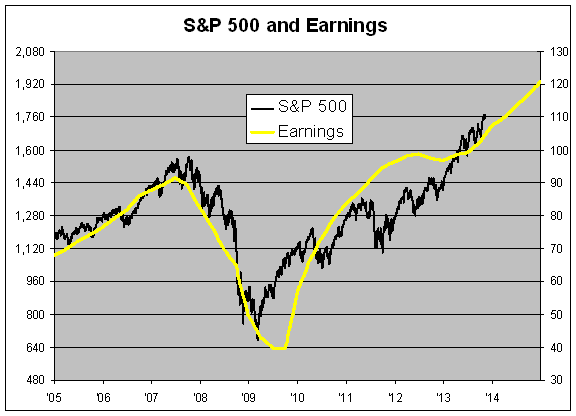
(Drivebycuriosity) - Yesterday the bull market celebrated his 5th anniversary. Since March 9th 2009 US stocks, as represented by the S&P 500, gained 175%.

A bull market is defined as a gain of at least 20% since a low, if the stocks fall at least 20% from a peak we call that bear market. The current bull market reached just the average length of historical bull markets. If stocks could repeat the rally from 1987 through spring 2000 than this bull market would live at least 8 years more.

I believe that the current bull market could even outrun the bull market from 1987 till 2000 (13 years). Many commentators claim that the stock market rally owes her existence only to the massive monetary stimulus programs by the Federal Reserve (QE1, QE2, QE3) and will blow out when the monetary stimulation ends. But those skeptics are too focused on the Fed and ignore other factors like the rise in company earnings. Profits for S&P 500 companies have climbed an average 21% a quarter since 2009, almost double the growth rate during the dot-com boom, writes Bloomberg (bloomberg). Thus, the stock market has just accompanied the climbing company profits which gained around 170% since 2009 (crossingwallstreet).


I am convinced that the observed rise of the company profits is a long term trend and will continue in the coming years. During the recessions of the years 2001/02 and 2008 companies restructured and reduced costs significantly in order to survive. Now they are much fitter and more efficient than before. I believe that this learning process will continue and that companies will become even more efficient and productive which translates into rising company profits for many years to come.


My optimism is based on the observation that companies are benefitting from a new industrial revolution which we are experiencing now.  There are accelerating advances in Internet, mobile computing, 3-d-printing, robotics, nano- & biotechnology and other fields which are all reducing costs, raising efficiency and creating new markets.

I also expect that the tailwinds from the emerging markets will come back soon. The catching-up process in China, India and a lot of other countries will continue and should translate into high growth in large parts of the global economy benefitting global companies in the U.S. and Europe. 


Thursday, March 6, 2014

Movies: Tim´s Vermeer


(Drivebycuriosity) - Johannes Vermeer was a revolutionizer, kind of. The Dutch painter lived in the 16th century and created images which were different from the works of his colleagues. Vermeer´s paintings look like modern photo-realistic paintings because of their accuracy and the unique use of light (wikipedia). The British artist David Hockney and others believe that Vermeer must have used a camera obscura, a precursor of a movie projector, to create his stunning effects.
 
The movie "Tim's Vermeer", shot by the magicians Penn & Teller, follows Tim Jenison (imdb). The documentary shows how the Texan engineer, software developer and inventor painted an exact copy of Vermeer´s "The Music Lesson" with the help of a self-constructed camera obscura and a mirror in order to prove Hockney´s thesis. VanityFair has a nice and long article about this project (vanityfair).

I liked the film a lot. I was impressed how stubbornly methodical and painstakingly Jenison realized his obsession.  I also enjoyed the beauty of Vermeer´s paintings which fanned my appetite to see more of his work. The movie is highly recommended for art lovers and connoisseurs of well made documentaries.


Wednesday, March 5, 2014

Geopolitics: Ukraine Conflict - Why Punishing Russia Is A Bad Idea


(Drivebycuriosity) - It looks like that the Cold War is back. Russia occupies Crimea, a part of Ukraine, and the West (U.S. and European Union) is talking about drastic sanctions to punish Putin like freezing Russian assets (accounts) and blocking imports (like oil & gas).

I don´t like Putin and I despise his aggression, but anyway, I believe that severe sanctions are a bad idea. The call for punishing Russia reminds me of the late 19th century when the colonial powers sent gunboats up the Shanghai River to punish the Chinese who refused  to buy their opium. Today punishment is even controversial on the school yard. It is strange that Americans who don´t punish their kids want to punish every nation in the world that doesn't behave well.  Punishment isn`t appropriate for the complex geopolitics of the 21 century.

I don´t believe that Putin can be tamed. Neither that he can be intimidated by punishment. Dislike him as much you want, he is the leader of one of the most important countries of the world, a giant  as commodity exporter and a nuclear power. Sanctions might even provoke him. Ex-KGB-officer Putin, who has a black belt in Judo, has been cultivating his über-macho reputation for years. And he has to impress his backers in Russia. Thus, when punished, the Russian leader might act even more aggressive. Where would this lead?

The "punish Russia" callers want to make Putin pay for his actions. Yet, it is not sure that sanctions will put high costs on Russia as the punishment advocators claim. Last Monday prices for oil, wheat and other commodities already jumped - fueled by speculation on an escalation of the Ukraine conflict. Russia as a big exporter of oil, natural gas and other commodities would certainly benefit from an oil price rise! If Europe would buy less Russian oil and gas (how would they do that?), China, India and other countries would be happy to buy it.

And even if Russia would bear costs, how should that stop Putin? Not even Fidel Castro and his successors changed their politics because of the ridiculous US embargo (no Cuban cigars). Russia is not managed like a company which is traded on Wall Street. And who knows how Putin´s cost/benefit calculation looks like. Maybe he values the advantages of controlling Crimea/Ukraine higher than the costs of sanctions?

Otherwise the West would have to pay high costs of sanctions by themselves. The Western economy would get hurt if the conflict with the oil exporter Russia leads to much higher energy prices. In 2008 just the speculation on a war with Iran raised the oil price to $147 which severely sharpened the recession in the US and Europe (econbrowser).


Sanctions also could provoke Russia to retaliatory strikes which could lead to a full fledged trade war. Europe would have to bear the highest burden. Russia is the third largest foreign customer for the European industry and imports cars, machines, medicaments, chemical products and more. And Europe receives a lot of oil & natural gas (Germany a third) from Russia. An official British paper revealed that UK (banks and other companies) had investments in Russia of more than £46bn ($76bn) in 2011 (the latest year for which data is available), rather more than Russian investments in the UK of £27bn ($45bn) (bbc). The US deals much less with Russia but an economic setback in Europe would hit American exports and banks. And US companies like Apple, Caterpillar and others are also exporting to Russia.

I am convinced that the costs of the punishment for the West - especially for Europe - are higher than for Russia, mainly because of rising oil prices. I suppose that Putin is aware of that and will respond accordingly. Putin also knows that the governments of UK and Germany would risk their reelection if a trade war with Russia leads to severe energy supply problems while he as an autocratic leader has not this issue. I hope that the so called leader of the Western World act less autocratic and consider the costs of their actions for their countries.

Tuesday, March 4, 2014

New York City: Impressions From A Sheer Endless Winter

(Drivebycuriosity) - It looks like that this winter doesn´t find an end. This morning in Manhattan the mercury fell again to the low tens (around minus 8 Celsius). I have enough of the polar vortex which transforms the city into a fridge.


But people have adapted to the chill. And the winter also has some beautiful aspects. Here some impressions from late winter in Manhattan.


Enjoy.

Monday, March 3, 2014

Economy/Politics: Are Academics Irrelevant?


(Drivebycuriosity) - "Academics don´t matter in today’s great debates", claims New York Times columnist Nicholas Kristof. "Some of the smartest thinkers on problems at home and around the world are university professors", he writes, but the profession is "irrelevant" (nytimes).

I agree, it seems that university scientists don´t participate in the public discussion. This is a huge shortfall. Science could be a great help to analyze problems and to develop solutions.

The Ukraine conflict is the newest example for this issue. You can find a lot of opinions from politicians, journalists, bank analysts and investment advisers, but there are not many contributions from the academic world - if any. Yet, the quarrel between Russia and the West (U.S. & Europe) and the possibility of sanctions against Putin would be the perfect field for game theorists who study the implications of action and response (wikipedia). Though, game theory - as it is researched & taught at universities - is highly abstract.  Game theorists usually work with mathematical models (equations) which don´t comply with practical current issues like the Ukraine conflict. The reality is too complex to fit into the streamlined models of these scientists.


I suppose that the focus on mathematical models is a general issue of university economics and other sciences.  I used to work as a science editor for a German economic magazine and tried to build bridges from the academic world (university economists) to the public (readers of the magazine). But the academics weren´t very cooperative. It seems to me that the majority of the academics is more interested in the elegance of their theories than in their practicability.

The majority of academics seems not to care about their public influence. They focus on writing highly academic papers which are relevant for their careers. These papers are published in extremely specialized - and very expensive - academic journals which are only read by other academics - a somewhat incestuous system. The focus on publishing academic papers, which is very time-consuming, also hinders academics to respond to current issues. When I asked them about a current problem, they told me that this is interesting but they didn´t have the time to deal with that.

But I also learned as a science editor that the public (the majority of the readers ) isn`t much interested in scientific articles anyway - even when they are written in a graspable manner. Science has the reputation of being too complicated and boring. It seems to me that there is an insurmountable gap between university academics and the public.