Saturday, June 17, 2017

Movies: My Cousin Rachel


(Drivebycuriosity) - British novelist Daphne du Maurier has inspired a row of interesting movies, including 2 Hitchcock films - "Birds" & "Rebecca" and the sinister but fascinating "Don`t Look Now", directed by Nicolas Roeg. This drew my attention to another movie adaption of her novels: "My Cousin Rachel", which is now running in US cinema theaters (imdb).

The film is passable but doesn`t play in the league of the above mentioned movies. The plot, set in the 19th century England (Cornwall), is about a complicated relationship and about leeriness & jealousy. The story didn´t work for me, the plot is a bit too old fashioned for my taste and not really plausible. But the amazing cinematography overcompensated the flaws of the plot. Cinematographer Mike Eley worked almost like a painter and created amazing images. The cast is another plus. I enjoyed watching Rachel Weisz as the mysterious cousin, but I was even more impressed by the supporting actors who played as peasants & servants, especially by Tim Barlow (born 1936) in the role of the butler & administrator.

"My Cousin Rachel" may work for movie lovers who have a taste in beautiful shot historical mysteries.


Friday, June 16, 2017

Contemporary Art: Robert Rauschenberg @ MoMa New York


(Drivebycuriosity) - Robert Rauschenberg belonged to the most influential artists of 20th century. New York´s Musem of Modern Art (MoMa) has now a show called "Robert Rauschenberg Among Friends "(through september 17 2017  moma ). Rauschenberg belonged to these artists who used then innovative new materials like silkscreen-ink print. According to the press release the American had "an egalitarian approach to materials, bringing the stuff of the everyday world into his art". Some of the results you can see below.  I guess that he was very provocative & innovative in his times. Some of his works hid my taste button, they look funny & entertaining to me, some don´t.

Here are my favorites from the show, a very subjective selection as usual. On top of this post you can see "Persimmon" (1964, oil and silkscreen-ink print on canvas) followed by "Tracer" (1963,  oil and silkscreen-ink print on canvas).


Above "Retroactive I" followed by "Kite"; "Estat" & "Press" (all: oil and silkscreen-ink print on canvas).                          


                        Taxidermied Eagle


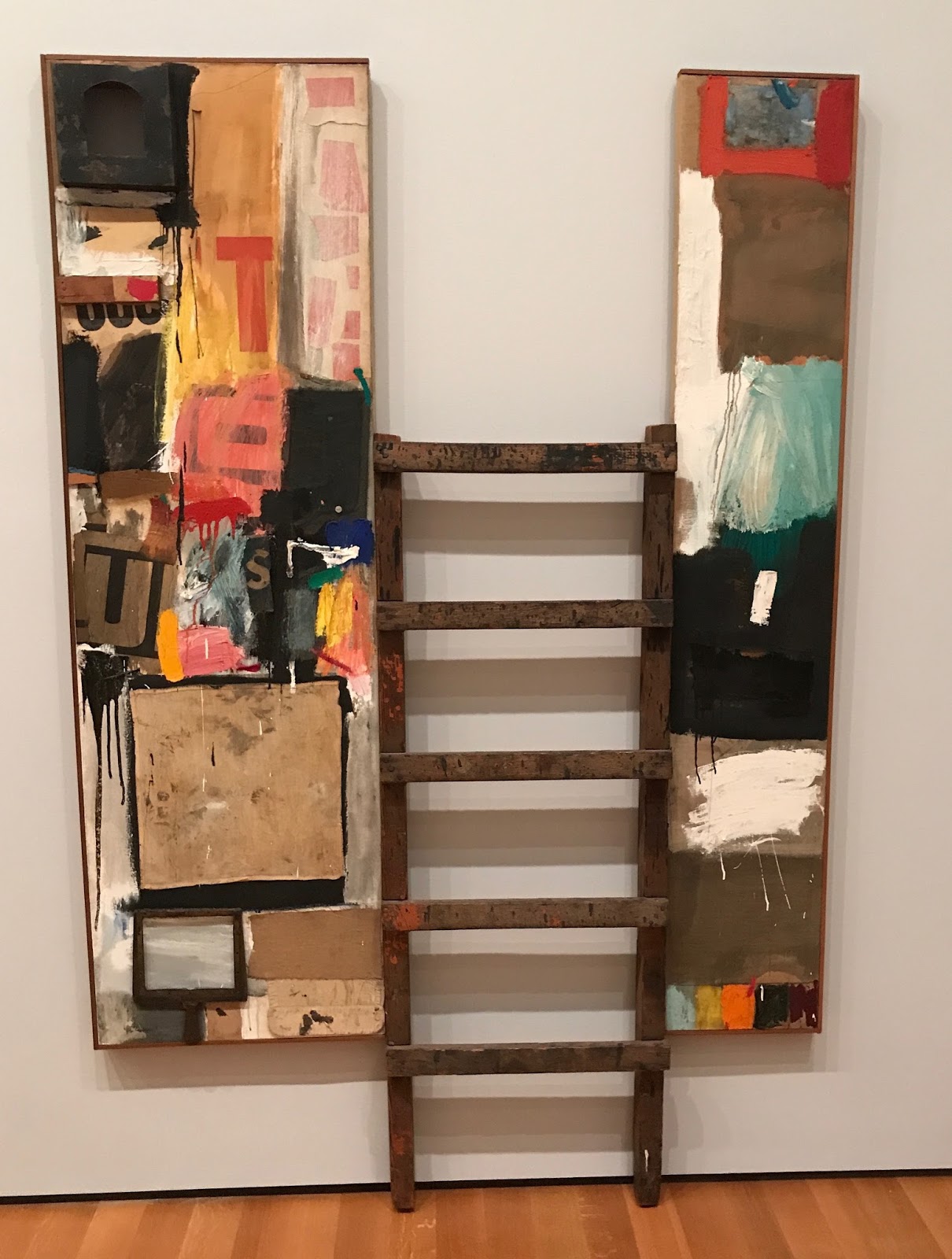
Above some of his wild compositions: The wall filling "Ace" (1962, oil, paper, cardboard, paint-can label, umbrella, doorknob, fabric, wood, nails, and metal on canvas, five panels) followed by "Rhyme" (1956, oil enamel, and spray paint, pencil, paper, fabric, and necktie on a repurposed canvas); "Canyon" (1968, oil, pencil, paper, photograph of the artist`s son, manufacturer´s tag, postcard, printed reproductions, flattened industrial metal canister, fragments of a man`s shirt, fabric-covered mirror, paint tube, wooden knob, cardboard box, and other materials on canvas, with oil on taxidermied bold eagle, wood beam, and pillow suspended by fabric) & "Winter Pool" (1959, oil, paper, fabric, wood, metal, sandpaper, tape,printed paper, printed reproductions, fragments of a man`s shirt, handkerchief, handheld wood bellows, and found painting on two canvases joined by wood ladder).


Above you can see "Sue" followed by "Female Figure" (both 1950, exposed blueprint paper)


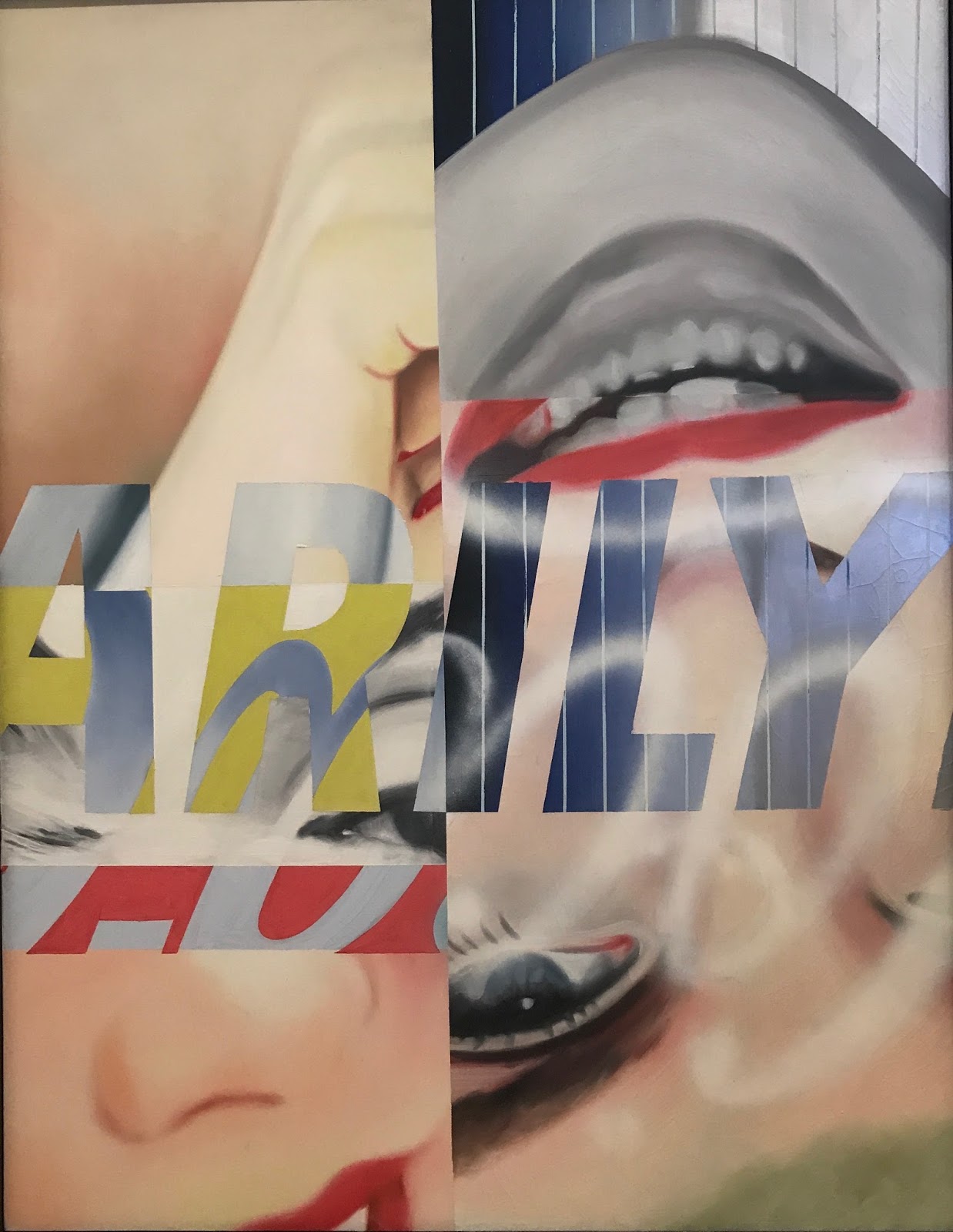
Some of Rauschenberg´s friends`works caught my eyes as well. Above you can see "Marylin Monroe I" by James Rosenquist (1962, oil and spray enamel on canvas). At seems they had influenced each other.


Andy Warhol belonged also to Rauschenberg´s friends. Above "Gold Marilyn Monroe" (1962, silkscreen ink on synthetic polymer paint on canvas).


Enjoy!

Thursday, June 15, 2017

Economy: Inflation R.I.P.?

(Drivebycuriosity) - It looks like that inflation is dead and buried - at least for a while. In May the US inflation rates went down (inflation). Consumer Prices rose 1.9% (April 2.2% ), the core inflation rate - without energy & food prices - dropped to 1.7% from 1.9%.

It seems that the technological progress is keeping inflation at bay.  Computers and other electronics have been getting cheaper all the time. In many industries are rising labor costs compensated by automation - at least partly. And many consumer goods are kept cheap because Amazon and other E-Commerce companies are getting more & more efficient which translates into cost savings and lower prices. 

Yesterday´s Fed decision to hike interest rates another 1/4 percent point to a range of 1% - 1.25% is also restricting the scope for prices in the near future. The rate hike is a sign that the monetary authority is aware of the inflation risks and ready to work against them.

Inflation is also suppressed by shrinking prices for oil & other commodities. The technological progress is stimulating oil production (for instance by fracking) and curbing oil demand (rising energy efficiency).  Today crude oil costs 8% less than a month ago and average US gasoline prices dropped 5 Cents since last year same time (aaa.com). I think that the ongoing technological progress will keep oil prices at bay and that oil will stay cheap for a long time.  Cheap energy is curbing transportation costs which influences prices of many goods, including food. So the inflation numbers for June could fall again and should stay low for months to come.

I believe that cheap commodities, E-Commerce & other technologies in combination with a prudent monetary policy will prevent a comeback of inflation for years to come. This is good news for the economy because low inflation rates translate into moderate costs for companies and will leave more money in the wallets of the consumers.  

R.I.P. Inflation

Wednesday, June 14, 2017

Photography: The Faces Of Manhattan


(Drivebycuriosity) - Manhattan has thousands of faces. It`s a paradise for amateur photographers like me because the are ubiquitous motifs. Naturally there is not enough space to display all of them here. In this post I show recent favorite Manhattan pics, all shot in the last 30 days.

Above you can see Jeff Koon`s "Seated Ballerina" @ Rockefeller Center. 


On Washington Square I spotted this exercise class.


People are crossing the Brooklyn Bridge or watching Cruise Ships on Hudson River. There are jogging along the East River or having a photo session there.

Some kids are flying their kites (also along East River).


There is hustle & bustle in Midtown, Chinatown & on East Houston Street.


Manhattan has a lot of pretty sceneries.


                         Witches On Ludlow


and I indulge into the diversity of Manhattan`s architecture.


Even the plenty construction sites are fine motifs.


Are there witches conspiring on Ludlow Street?

Enjoy!

Sunday, June 11, 2017

Stock Market: What Caused Friday`s Flash Crash In Tech Stocks?

(Drivebycuriosity) - Maybe last week´s Friday`s stock market performance will be discussed a long time. Something rare happened: A flash crash. Fortunately the phenomena was limited to the  technology stocks sector.


                                                              QQQ = Nasdaq 100


Shortly after opening technology stocks started dripping. In the following hours the drop accelerated and minutes before 3 pm the movement turned into a sharp fall, only to recover most of the losses by the closing bell. Above screenshots from the QQQ which represents Nasdaq 100.


                                                        Feral Hogs


Some stocks, including Facebook, Alphabet (Google), Netflix & Amazon, got even hit harder. Above screenshots from Amazon`s performance of Friday. Amazon opened at $1,012,50, close to the all-time high ($ 1,016,50), shortly before 3pm the price suddenly plunged to $927,00 - a intraday loss of about 9% -, but recovered to $978.31 at closing bell.


It seems that many investors got spooked by the recent stock market gains and the all-time-highs. After Friday´s close the Nasdaq 100 had still a gain of 18% year-to-date & 28% y-o-y. So many took some money from the table (profit taking). Crowds behave unpredictable, sometimes many do the same. It seems that the slow slide animated more investors to take profits, apparently this encouraged hedge funds and other short sellers to amplify their bets against the stock market. So the slide accelerated, causing more selling - typical herding behavior. Falling stock prices also triggered stop-loss-orders. Many professionals set these sell orders to prevent further losses. Apparently short before 3pm all these factors came together and triggered a sudden implosion of the tech sector. But reduced stock prices attracted new buyers and so the stocks could recover the most extreme intraday losses.

Crashes are typically mass market phenomena caused by herding behavior. A crash is a special type of a stampede. The phenomena is known from cattle - and other herd animals - which sometimes panic all together and trample down everything which is in their way.  Lemmings are another infamous example of self-destructive crowd behavior. Stampedes are a violent form of herding behavior, the members of a group suddenly behave all in the same way. It is known that hedge funds behave as a herd, they buy what others buy and they sell what others sell, so they are amplifying their behavior.

It is possible that some hedge funds and other groups of short sellers had tried to use the slide for their purpose. Many of them have been betting against the stock market for a while. Maybe they had sensed a chance and had pooled & intensified their sales shortly before 3pm in order to trigger a market collapse. Federal Reserve member Richard Fisher (Dallas Fed President) described these groups as " big money" that "does organize itself somewhat like feral hogs. If they detect a weakness or a bad scent, they go after it"  (marketwatch ).


                                                                   S&P 500


                                                               Dow Jones


If it was the intention of the feral hogs to cause a full fledged stock market crash - similar to the famous crash of 1987 - they failed. The sharp losses of the technology sector did not spread over the full market. Above & below are screenshots from the S&P 500, the gauge of the US stock market, which was almost unchanged (minus 0.08% ), the Dow Jones even had a gain of 0.4%.


It seems that the broad market got saved by bank stocks which soared on Friday. They got a boost from the Trump administration which reduced a costly bank regulation (Dodd-Frank banking law).

I think that Friday´s setback for technology stocks was unjustified because the sector has fast growing earnings and strong perspectives (driveby ).