Tuesday, June 25, 2019

Culture: A Walk Through British Art History - Meet The Pre-Raphaelites & The Victorians @ Tate Britain London


(Drivebycuriosity) - My wife and I are staying in Vauxhall, the first part of our long London visit. The place is relatively close to the Tate Britain where admission is free. That inspires us to visit the museum more times. I already reported about their Van Gogh show ( driveby). We are exploring also their regular collection which is displayed in chronological order, each room contains a certain historical period, beginning in the mid-sixteens century. I blogged already about their collection through the early 19th century  (driveby  ). During our next visit we focused on the 19th century art and artists which are called Pre-Raphaelites  & The Victorians. Here I present my favorites from , a very subjective selection as usual.
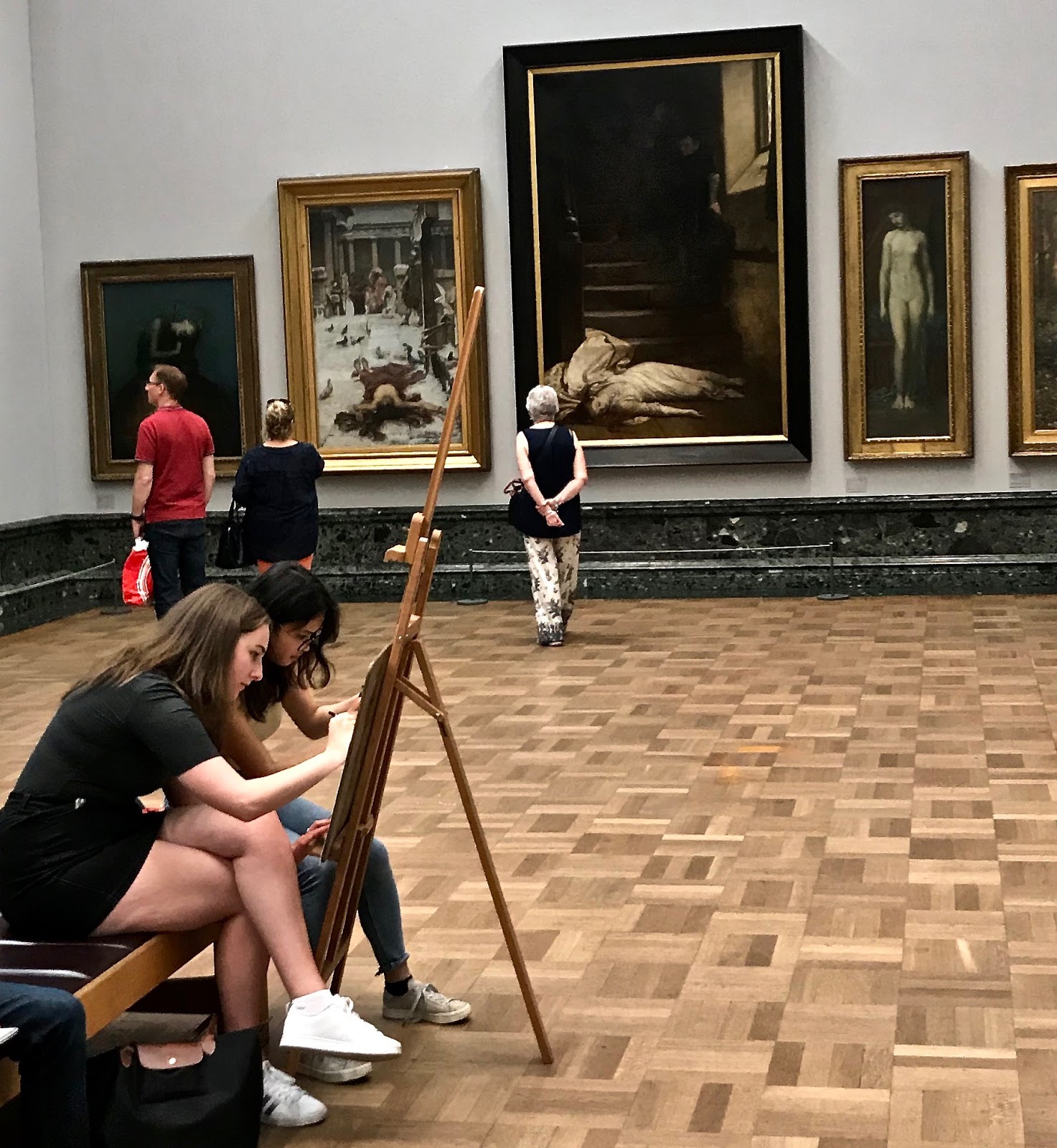
 

The Pre-Raphaelites was a group of English painters, poets, and art critics, founded in 1848  ( wikipedia ). According to Wikipedia "the group's intention was to reform art by rejecting what it considered the mechanistic approach first adopted by Mannerist artists who succeeded Raphael and Michelangelo. Its members believed the Classical poses and elegant compositions of Raphael in particular had been a corrupting influence on the academic teaching of art, hence the name "Pre-Raphaelite". I like their unique style which is flamboyant and sensual. The Victorians existed during the long regency of Queen Victoria (1837 until 1901 ), the Victorian epoch  ( wikipedia ).


Above you can see 2 famous Pre-Raphaelite ladies: Dante Gabriel Rossetti`s "Proserpine from 1874" followed by Théodore Roussel`s The Reading Girl from 1886–7. 


Above Simeon Solomon`s "A Youth Relating Tales to Ladies from 1870" .


Above details from Sir John Everett Millais, Bt`s "Christ in the House of His Parents (‘The Carpenter’s Shop’)"  from 1849–50.


Above Augustus Leopold Egg`s "Past and Present, No. 1 from 1858".  The  curators explain "the theme of the triptych is the discovery of the woman's infidelity and its consequences. In this first scene the wife lies prostrate at her husband's feet, while he sits grimly at the table and their children (the older girl modelled by William Frith's daughter) play cards in the background. The husband is holding a letter, evidence of his wife's adultery, and simultaneously crushes a miniature of her lover under his foot. The setting is an ordinary middle-class drawing room, but closer observation reveals that the room is full of symbols. Egg was clearly influenced in his approach by Holman Hunt's The Awakening Conscience of 1853 (Manchester City Art Galleries). The house of cards is collapsing, signifying the breakdown of the couple's marriage. The cards are supported by a novel by Balzac - a specialist in the theme of adultery. An apple has been cut in two, the one half (representing the wife) has fallen to the floor, the other (representing the husband) has been stabbed to the core. As a parallel, the two pictures on the wall depict the expulsion of Adam and Eve from the Garden of Eden (labelled The Fall); and a shipwreck by Clarkson Stanfield (labelled Abandoned). The couple's individual portraits hang beneath the appropriate image". 
.


Above Walter Crane`s "The Renaissance of Venus"  from 1877.


Above Stanhope Alexander Forbes` "The health of the Bride" from 1889 &  Richard Redgrave`s "The Sempstress" from 1846.


Above William Frederick Yearnes` "Amy Robsart" from 1877 & Atkinson Grimshaw`s "Liverpool Quay by Moonlight"  from 1887.


To be continued

Friday, June 21, 2019

Contemporary Art: Anish Kapoor @ Lisson Gallery, London


(Drivebycuriosity) - Anish Kapoor is one of the most interesting contemporary artists ( wikipedia ). It seems that the sculptor & painter, who is born in India and has lived and worked in London since the early 1970s, likes to surprise & provoke. In the year 2006 I reported about a Kapoor show in New York  ( driveby ).      


My wife and I took the occasion of our London visit to see a new Kapoor exhibition @ Lisson Gallery near the Regency Park   ( lissongallery ). Above you can see Blood Solid  (2018, oil on canvas ). I love the dynamic and the strong red. But let the images speak for themselves.     


Above Out of Me  (2018, oil on canvas )      


Above New Blood followed by Matter Apart  & Teeth  ( all 2018, oil on canvas )      


The paintings above are all Untitled. The first 2 are from 2019 and oil on canvas, the 3rd is from 2016 and silicone, fibreglass and gauze.


The sculpture above is Untitled from 2018. It is made from one piece of Pink Onyx.


This outdoor sculpture is Untitled and from 2018. It is made from Iranian Onyx.


Above you can see a sculpture which is called Rectangle within a rectangle from 2018. Made from Granite.

To be continued    

Thursday, June 20, 2019

Economics: How An Intelligent Society Would Deal With Climate Change

(Drivebycuriosity) - Everyone is talking about climate change. Here are some thoughts how a really intelligent society could reduce the emission of greenhouse gases in order to curb global warming. An intelligent society would implement this in the most efficient way. It would build a network of high speed and similar trains - including subways - in order to replace most of the car traffic. The electricity would be generated by nuclear power plants which emit zero greenhouse gases. They also would deliver cheap energy for homes (heating, cooking). These steps could reduce greenhouse emission by at least 20%.


The necessary huge infrastructure investments should by done by private investors and not by governments which are bureaucratic and inefficient. Investor Elon Musk already started to construct tunnels . The private enterprises could finance these investments by long term bonds which are backed by the government. In these case the bonds would carry low risks - not more than governments bonds - which would keep the interest rates low.

An intelligent society would also eliminate building restrictions in the cities. Today many cities have strict zoning rules which restrict the highs of the buildings. As a result  too few flats get constructed which makes them expensive. If the cites would skip the zoning rules and allow much higher buildings then living in big cities would get much cheaper and would attract more people to move there.

I live in New York City and I don´t need a car (and I don`t have one) because the distances are short. Most things can be done by walking or using subways & buses. If a large part of the US population - today about 320 million people - would move to New York City, Los Angeles, Dallas, Chicago, Atlanta and other metropolises these communities would become megacities with each more than 10 million residents. The same would happen in other countries. I think New York City, London, Madrid, Paris  & Co. could get much bigger and denser if they grow vertical. Skyscrapers  -  especially the new slim towers you can see now in Manhattan - don´t need much space. Upwards is a lot of space, thanks to modern technologies. These towers multiply the number of available apartments per square foot.

If a large part of the US population - and other countries - would live in megacities the nature could recover.  Today large parts of the US - and other countries - are covered with concrete (houses, malls, streets) thanks to the vast sprawl. This land could be replanted with forests, bush- and grassland would also curb the greenhouse effect and could be used for recovering.

The growth of mega-cities would raise the consume of electricity of course - for subways, electric buses, elevators and such - which today creates already nearly 30% of the greenhouse gases (chart above). The US and other countries could follow France which reduced the CO2 emission by generating more electricity by nuclear plants. Today the French create about 80% of their electric power from nuclear plants, which emit zero CO2 (cleantechnica). More electric power by nukes would also lower the cost for electricity and animate to use more of it for residential uses (heating, cooking), which today generates about 10% of the greenhouse gases.  So the raise of mega-cities combined with a revival of nuclear energy could reduce the emission of CO2 significantly.
 
Bigger and  denser cities connected by networks with fast trains electrified by nuclear plants would stop climate change. But are societies intelligent enough to implement the changes?

Sunday, June 16, 2019

Culture: A Walk Through British Art History - Renaissance, Baroque & Neoclassicism @ Tate Britain London


(Drivebycuriosity) - My wife and I are staying in Vauxhall, the first part of our long London visit. The place is close to the Tate Britain where admission is free. That inspires us to visit the museum more times. I already reported about their Van Gogh show ( driveby). On Thursday we started to explore their regular collection which is displayed in chronological order, each room contains a certain historical period, beginning in the mid-sixteens century   (tate.org  ). I present here my favorites, a very subjective selection as usual.


Above the painting which fascinated me most: John Singleton Cople`s "The Death of Major Peirson, 6 January 1781", executed 1783. This picture celebrates the British defense of Jersey against French invasion in 1781 and also pays tribute to a young Major, Francis Peirson, who lost his life in the process.


I am also impressed by Joseph Mallord William Turner`s "The Field of Waterloo",  exhibited 1818. England `s victory over Napoleon had a high price and Turner went to the battlefield in order to document the horror.


Above Peter Monamy`s "Ships in Distress in a Storm" from 1720–30 


Above Samuel Scott`s "An Arch of Westminster Bridge" from 1750.


Henry Fuseli`s "Titania and Bottom" from 1790.


And more lovely ladies: Sir Peter Lely`s "Susanna and the Elders"  1650–5 &  "Elizabeth, Countess of Kildare"  1679,  Paul Van Somer`s "Lady Elizabeth Grey, Countess of Kent"  1619, Sir Nathaniel Bacon`s "Cookmaid with Still Life of Vegetables and Fruit"  c.1620–5 & an unknown artist`s "A Young Lady Aged 21" , Possibly Helena Snakenborg, Later Marchioness of Northampton,1569 .


"The Cholmondeley Ladies" by another unknown artist, 1600–10.


To be continued