Saturday, November 27, 2021

Science Fiction: Mitigated Futures By Tobias S. Buckell


(
Drivebycuriosity) -  Tobias S. Buckell belongs to the stars of the contemporary science fiction genre. According to Wikipedia he is a New York Times Bestselling author and won a World Fantasy Award and many other trophies (wikipedia ). I enjoyed his
very subtle and thought provoking short story  "Zen and the Art of Starship Maintenance” (reprinted here  here ). The plot is told in first person by a robot with artificial intelligence (AI) who does maintenance works on the hull of a space ship. This AI has to deal with a superior power which causes a conflict of interests.

The story inspired me to purchase Buckell`s short story collection: "Mitigated Futures" (amazon ). Unfortunately non of the 12 stories worked for me, I skipped reading each of it. I even wondered if this book is published by the same Buckell.

I glance in the quoted Wikipedia article gives an explanation. Buckell is a very profilic writer, maybe too prolific. In a few years he published more than a dozen of novels & novellas plus tons of short stories. Too much quantity kills quality.


Thursday, November 25, 2021

Stock Market: Happy Thanksgiving 2021


(Drivebycuriosity) - Today the Americans celebrate Thanksgiving. The feast reminds of the pioneers who lauded their harvests and their survival in the harsh environment of the 17th century. This is the second Thanksgiving in the Covid-19 pandemic, but in the US anyone who wants it can get vaccinated, at least twice. And now are additional (booster) shots available which give about 95% immunity.

Investors also have plenty reasons to celebrate. The US stock market climbed in the recent days to a new all-time high. The S&P 500, the gauge for the US stock market, gained 23% year-to-date, 31% y-o-y and continued the positive trend of the recent years (chart below). 


 ( source)


The stock market accompanies the seemingly eternally  rising company profits. Both are fueled by the accelerating technological revolution which got boosted by the Covid-19 crisis. It seems that the pandemic started a new Roaring Twenties, comparable to the boom phase which happened during the 1920s years after the Spanish Flu. 

Covid-19 accelerated the fundamental trends that have been shaping economy & society in the recent decade. During the pandemic the rise of the Internet gained even more speed and turned into a great leap. The pandemic reduced the resistance against technological progress (faz.net ). The crisis forced many people to work at home, to learn, shop, educate & entertain themselves from home. These trends are fostering digitization and raising efficiency & productivity of the economy. 

The virus boosts the digitization process, which is fostering productivity across all industries, leading to more economic growth. Microsoft`s CEO Satya Nadella said "the pandemic has proven the PC’s central role in keeping people connected, productive, and secure ...What we are witnessing is the dawn of a second wave of digital transformation sweeping every company and every industry" (transcript ). Last year Nadella noticed that “two years of digital transformation took place in two months” ( microsoft ). 

Online sales worldwide are surging, more people are working from home, they are binge watching Netflix & Amazon Prime, listening via Spotify, reading Kindle books, surfing Facebook & Twitter and businesses are running more & more on cloud computing. Home office & remote learning are raising productivity of the whole economy because many people spend less time with commuting. 

Not only consumers changed their behavior, companies were forced to adapt as well. We are witnessing an accelerated shift toward digital technologies that are faster, less expensive, more productive and raise creativity. Companies are compelled to streamline operations and they are using more & more Internet & and other software applications to get more efficient, creative & productive. The pandemic forced them to get faster and make their products & services cheaper and more convenient. These changes are accelerating the ongoing digitization process, using Internet and other software applications more intensely. The CEO of Bill.com, an online service, said: "We believe the ongoing pandemic has accelerated the need for businesses to focus on digital transformation” (seekingalpha).

Covid-19 made the companies much fitter and more efficient than before which translate into climbing profits. I believe that this learning process will continue and will fuel a long term trend of rising company profits & stock markets.

Happy Thanksgiving!


Wednesday, November 24, 2021

Books: The Twelve Lives Of Alfred Hitchcock By Edward White


 (Drivebycuriosity) - Alfred Hitchcock defined cinema and mingled entertainment with art. The biography "The Twelve Lives of Alfred Hitchcock" by Edward White shows how and why "Hitch" performed his magic ( amazon).

The book is not in chronological order. In each of the 12 chapters the author focuses on one special aspect of Hitchcock`s live and personality. We learn about Hitch`s anxieties, his voyeurism, his economic talents, his relations with women (would Hitch survive today´s me-too climate?), how he staged his obesity in public, how his talents got shaped by early German cinema and how Hitch developed after his move to America and much more.

The author condensed a vast amount of material into a very readable book. His portrait is analytical, but also entertaining. If it is possible to explain a genius, Edgar White came close to it. And "Twelve Lives" woke my appetite to re-watch Hitch`s masterpieces again.

Monday, November 22, 2021

Art Market: New York`s Fall Auctions 2021 Redux - An Eclectic & Subjective Glance


(Drivebycuriosity) - In the recent days New York`s huge autumn art auctions happened, showing the state of the art market. According to the Wall Street Journal Sotheby`s, Christie`s & Phillips - the three world market leaders - sold together art work for $2.3 billion - a new record for them and for the global art market. 

I am not surprised. As I wrote before, the global art market follows the US stock market which climbed to a new record high as well ( driveby). Many investors are pouring their money into risky assets - including pricey art works - hoping on further rising prices (below a chart of the S&P 500, which represents the US stock market). It is not a coincidence that hedge fund managers and other finance people belonged to the top bidders.


 ( wsj.com     macrotrends )


I was overwhelmed by quantity & quality of the exhibited art works which could easily compete with a major art museum. I can show here just some tidbits - a very subjective and eclectic selection.


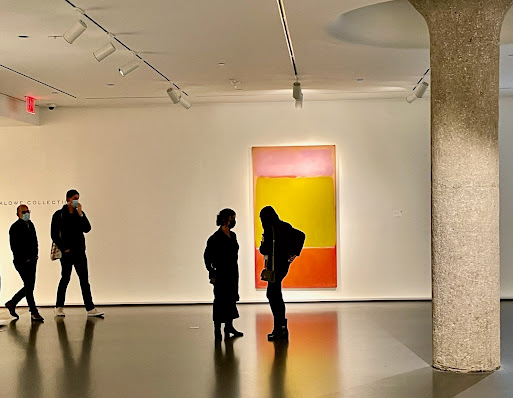
Star of the auctions was a Rothko which Sotheby`s auctioned for $82.4 million. The painting came from the hyped Macklowe collection. A Manhattan couple in  divorce needed to auction their amassed art works to find out its market value. Good for the art world and for humble art lovers like me who could see these magical painting from close.


Cy Twombly`s wall filling doodles ("Untitled", 1961)  got a lot attention as well.


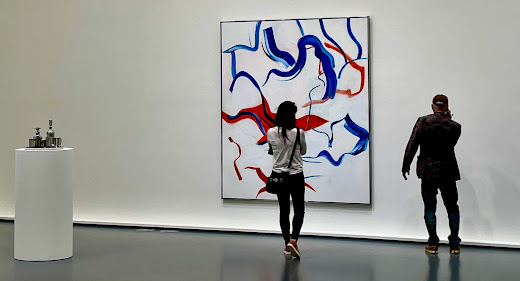
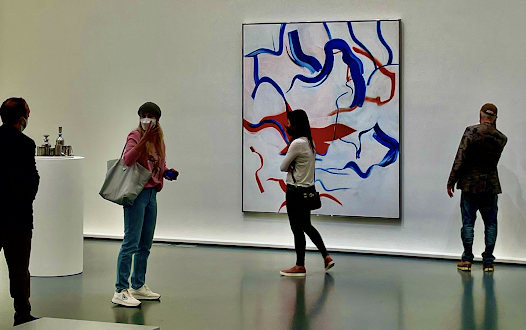
Joan Mitchell`s "Untitled" ( 1992) is a real eye catcher (seen @ Phillips).


Luc Tuymans` "Wallpaper" (2014) belonged to Phillips`highlights as well.


Helen Frankenthaler`s "Dream Decision" was another auction marvel (1976).


Eric Fischl`s “Best Western” (oil on canvas, 1983) crowns any salon.


This visitor is inspecting Jeff Koon`s "Gazing Ball (Titian Mars, Venus, and Cupid)".


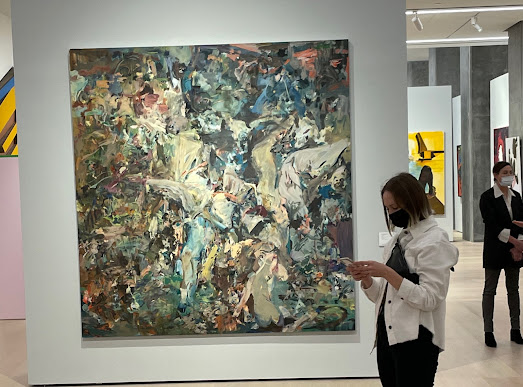
Cecily Brown belongs to the rising stars on the firmament of the art market. I enjoyed both "Untitled" works (2007 & 1997 ) @ Phillips and "Spree" (1999) @ Sotheby`s. Are these abstract paintings or do they show an orgy? You never can be sure with Brown.


Gerhard Richter is my favorite painter. He used to paint - in a photo-realist way - from a photo and then  rubbed a wet towel over it to create a blurring effect. Above you can see his "Sammler mit Hund/Collector with dog" (oil on canvas, 1966) and "Weiß (White)" (oil on canvas, 1988).


I am a fan of Sigmar Polke and Mark Tansey as well. Above Polke`s Rasterbild mit Palmen" (1966 ) and Tansey`s  "Garden" (2006).


Isn`t she wonderful: Javier Marín`s “Mujer Piedra II” clay from Zacatecas and Oaxaca with clay slip on metal artist's base, height: 41 in104 cm, 1998)


                  Blissful Discoveries


There were a lot of blissful discoveries. I was enchanted by Flora Yukhnovich`s wall filling "It’s Better Down Where It’s Wetter" (oil on canvas, 2018). This work alone was worth the visiting Sotheby´s. 


There were more gems: Karin Mamma Andersson`s "Med läsning öd ej iden borrt, VÃ¥rt kön sÃ¥ föga det behöver, Och skall du läsa, gör det kort, At sÃ¥sen ej mÃ¥ fräsa öfver / Readers" (2002); Lukas Duwenhögger`s elegant  "Rezalet (Impertinence) (1998); Hernan Bas` "Night Flight or Midnight Migration, or My Merry Way"  2008) & Hilary Pecis`"Sculpture Court" (2017).


Above follow Matthew Wong`s "Adam and Eve" (2016 ); Zsolt Bodoni`s "Turul's Sword" (acrylic and oil on canvas, 2009) & Jamian Juliano-Villani`s "Last Resort" (acrylic and mixed media on canvas, 2014).


Tomás Sánchez invited to meditate wit his  “Contemplador del contemplador” (acrylic on canvas, 1996) & “Encuentro con el meditador de la laguna” (acrylic on canvas, 1992).


 The auctioned also some avant-garde:  "Face Your Fears" by RISK (found metal objects,2019) & Ugo Rondinone`s “If There Were Anywhere But Desert, Saturday” (painted fiberglass with wig, clothing and glitter, 2002).


Sotheby`s also showed some works, including Remedios Varo`s "Les Feuilles mortes (Les heures mortes, El hilo)" (oil on board , 1956).


There were some awesome some classics as. Above the wonderful impressionist Pierre-Auguste Renoir. His lovely "Jeune fille à la corbeille de fleurs" sold @ Sotheby´s for $12,9 million. The late Renaissance painting by Artimesia Gentileschi`s "Portrait of a seated Lady", was earmarked for Sotheby`s Master Paintings Auction, New York January 27 2022.


I am grateful that even a humble blogger and art lover like me could enjoy this masterpieces without any admission fee and I could shoot as many photos I wanted. Thanks to Christie`s, Phillips & Sotheby´s.


Stay tuned

Saturday, November 20, 2021

Economics: Why We Need Billionaires


 (Drivebycuriosity) - In the recent days a funny twitter dispute happened (cnbc. ). Senator Bernie Sanders complained that the extremely wealthy don`t pay their fair share of taxes and Tesla`s CEO Elon Musk responded by tweeting "I didn`t know that you are still alive"  and continued with "Bernie is a taker not a maker". In the following days Musk started selling tons of his Tesla shares which will cause him a huge tax bill.

Sen. Sander´s aversion against billionaires is well known:


(cnn.com )


Bernie is wrong. America`s rise was driven by inventors & entrepreneurs who often became billionaires (in today´s money). America benefited from Samuel Slater, who developed a cotton spinning machine in the 18th century and from Oliver Evans, who created a flour mill. Steel magnate Andrew Carnegie & Cornelius Vanderbilt created a networks of railroads which had an important role in the development of the vast nation. In the early 1920s Henry Ford, who was obsessed with driving production costs lower, made cars affordable for the masses and created so a huge industry and wealth for the whole nation. The banker JP Morgan used his own huge fortune and his enormous influence on Wall Street to hinder the bank panic from 1907 to evolve into a full-fledged depression.

Yes, billionaires amassed fortunes, but we, the society, gained as well. Prof. Nordhaus, winner of Economics Nobel Prizes 2018, wrote in his 2004 paper “Schumpeterian Profits in the American Economy: Theory and Measurement,” : “Only a minuscule fraction of the social returns from technological advances over the 1948-2001 period was captured by producers, indicating that most of the benefits of technological change are passed on to consumers rather than captured by producers.” (aier.org). According to Nordhaus "producers, on average, capture a mere 2.2% of the total benefits of their successful introduction into markets of technological advances. A whopping 97.8 % of those benefits are enjoyed by people each of whom as a consumer did nothing other than exercise his right to spend his money on those options that he judges best for himself".

Today millions of Americans benefit from Sam Walton, who founded Walmart in 1962, by being able to purchase a lot of things for very low prices, especially people with a tight budget are better off thanks to him. Millions of Germans - and some Americans & British - buy cheap things @ the  supermarket chains Aldi Nord & Aldi Süd, founded & owned by brothers Karl and Theo Albrecht. Millions enjoy the comfort to have a huge variety of goods delivered fast & cheap to their homes - thanks to Jeff Bezos & Amazon. Bezos` obsession with customer service, low costs & prices forces the whole retail industry to get more efficient and customer friendly. It takes only a few clicks to make a purchase that will arrive at their home in about a day in most cases. The Amazon effect is making the economy more efficient & flexible. Many startups & established companies use Amazon`s cloud computing services (AWS) for processing & storing information. Bezos` Amazon also started cloud computing which reduces the costs of managing corporations, researching complicated topics and multiple other complex tasks considerably. Thanks to the cloud, new ideas can spread faster, which is encouraging discoveries and inventions. 

Google founders Larry Page & Sergey Brin became billionaires by offering online search,  maps & other  services for free. More than two billion people are using Zuckerberg´s Facebook to communicate with their friends & relatives worldwide without paying any cent. All these billionaire entrepreneurs made their fortunes because they had ideas,  took risks and worked hard - and they deliver a huge service to the society.

Sanders, Warren & Co. claim that the billionaire`s wealth would be in better hands when they take it away (wealth & capital gains taxes). Does the government really know how to use money better than these billionaires? Gates, Musk, Bezos & Co. have a proven talent for finding and investing in successful technologies & businesses. What business experience do Warren, Sanders & their bureaucrats have? 


( twitter)
 

Elon Musk doesn`t get a salary, he is paid in Tesla stocks which made him a billionaire and the car company can keep the money and invests in its business. Nike co-founder Phil Knight’s recalls in his memoir: Any dollar that wasn’t nailed down I was plowing directly back into the business” ( realclearmarkets).
 

Elon Musk invests a part of his wealth also in his "Boring Company" which builds tunnel boring machines. He wants to dig a network of cheap tunnels which are optimized for electric vehicles. Musk also plans to implement Hyperloop - a high-speed transportation system ( reduced-pressure tubes in which pressurized capsules ride on an air cushion driven by linear induction motors and air compressors). All these projects will make transportation much cheaper & environmentally friendly - creating another tailwind for the global economy.

Bill Gates invests a part of his fortune in a series of startups including Grail, a life sciences company working to develop technology that could spot cancer before it's incurable; Varentec, which develops products for electrical grid systems, including a software platform that lets cities more easily manage how power flows & EtaGena, a startup producing ultra-efficient generators that supply power for companies, buildings, and microgrids.
 

Jeff Bezos puts his private money into a variety of start-ups including EverFi, an online education and certification firm; Unity Biotechnology, a life-extension research firm hoping to slow or stop the process of aging; Juno Therapeutics, which aims to develop a pipeline of cancer immunotherapy drugs & Plenty, an indoor vertical farming company that uses less space and fewer resources to grow fresh produce year-round.

Bezos, Elon Musk & Richard Branson, the British owner of the Virgin Group, are also developing independently from each other rockets for space flights (Virgin Galactic, SpaceX, Blue Origin). The three billionaires aim to make space travel affordable by making rockets reusable. They do a service for whole world by risking their private money for space flights which may give humanity some day more chances to survive.

The investments by Musk & Co. are supporting the world and humanity by fostering innovation, reducing global warming through sustainable energy production and consumption, fighting cancer, supporting education and much more. If their money would be taken by the government it would get into the hands of bureaucrats which are less efficient & competent. Transferring money to the government often leads to waste, inefficiency & corruption as you can see in New York City where building a subway costs far more than elsewhere the world (marginalrevolution).

 The majority of US cultural institutions depends on charities financed by billionaires. At the end of 19th century people who had build great fortunes - like Henry Clay Frick, John d. Rockefeller &J.P. Morgan - began to found or endow museums, concert halls, orchestras, colleges, hospitals, and libraries in astonishing numbers in every major city (driveby ). The billionaire Carnegie - one of these donators - wrote, that "a man who dies rich, dies disgraced" and gave away  nearly his entire fortune. Cultural landmarks like Manhattan`s Carnegie Hall are financed by philanthropists. If you visit New York`s Metropolitan Museum of Art - or any other huge American museum - you might notice that most of the displayed art works are donated by some wealthy families or individuals (google). Even their running costs (administration etc) are partly financed by donations. Most American universities and hospitals are also funded by donations (forbes). The Rockefeller Foundation, based on the oil profits amassed by the Rockefeller family, has been supporting science, education, culture & health care for decades. Industrialist Peter Cooper initiated New York´s "The Cooper Union", which is still the only major college in the US which charges no tuition and John Jacob Astor founded the Astor Library, the core of the New York Public Library, the largest privately financed library in the world. Were would America be without billionaires?

In 2017 Americans gave over $400 billion to charitable causes with the largest growth in contributions coming from foundations created by major philanthropists (i.e. the ultra-rich). Warren Buffett and Bill Gates developed "The Giving Pledge" in 2010 to encourage the world’s wealthiest individuals to give away more than half of their wealth to charitable causes. To date more than 204 individuals and families have pledged to donate over $500 Billion. Bill & Melanie Gates Bill Gates declared that they are willing to give half their wealth to vetted charities of his choosing. Do Sanders, Warren & Co. really know how to spend this money more beneficial for the society?

Billionaires like Musk, Bezos, Gates are making the world a better place. The government should not try to stop them.  


PS On top of this post you can see a succesful test for Musk`s Starship (teslarati ).


Friday, November 19, 2021

Art Market: Impressionists, Modern Art & More - An Eclectic Glance On New York`s Fall Auctions 2021


(Drivebycuriosity) - I love contemporary art. So I went to New York´s auction houses to see their exhibitions for their fall auctions in Post War & Contemporary art. But Sotheby´s & Christie`s had more gems. They also displayed works they had amassed for their auctions of Impressionists & Modern Art (ca. 1870 - Word War II) and other events. I spotted there many awesome paintings and I display here my personal favorites, a very subjective selection as usual.


Above a painting by the wonderful impressionist Pierre-Auguste Renoir. His lovely "Jeune fille à la corbeille de fleurs" sold @ Sotheby´s for $12,9 million. Congrats to the buyer. 

Renoir´s collegue Claude Monet was the star at Sotheby´s. His "Coin du bassin aux nymphéas"  sold for $50 million. He will be happy, where ever he roams now. I believe I saw this painting some years ago at another big auction.


I personally prefer Edgar Degas` "Femme lisant" which sold at Sotheby´s for $2,7 million.


I was surprised to spot this amazing Renaissance painting there: Artimesia Gentileschi`s "Portrait of a seated Lady", earmarked for Sotheby`s Master Paintings Auction, New York January 27 2022.


Gustave Caillebotte´s  “Jeune homme à sa fenêtre” caught my eyes es well. Christie´s auctioned it for $53 million!


Frida Kahlo`s "Diego y yo" got also a lot attention @ Sotheby´s. The painting refers to her unfaithful husband.


                  Something for Everyone 


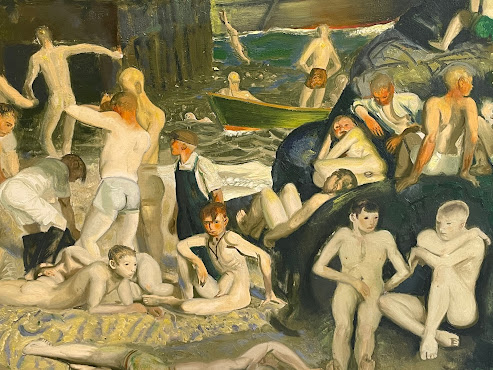
The merry crowd in George Bellows` "Riverfront" was executed in 1924, but it looks somewhat modern, doesn`t it?


 Colin Cambell Cooper`s "Chatham Square" from 1918 gives a glance on Manhattan`s past.


Above two surrealist works: Armando Morales`"En El Circo IV" and Remedios Varo`s "Les Feulles Mortes" plus the psychedelic "Spaziale fiorito" by Enrico Donati.


Last but not least some "delicatessen": Giovanni Romagnoli`s "Summer (Nude)" followed by Lenonor Fini`s "Les Aveugles"; Paul Delvaux`s "Le Soir Tombe"; Lucien Lévy Dhurmer`s "Female Nude" & Carlos Enriquez`s "Banista".


To be continued