Friday, July 5, 2013

Culture: Street Art - The Cult Of Stickers


(Drivebycuriosity) - The streets of Manhattan are full of surprises. There is so much to discover. Manhattan also is a mecca for street art. Many artists put their work wherever they find a place for it.


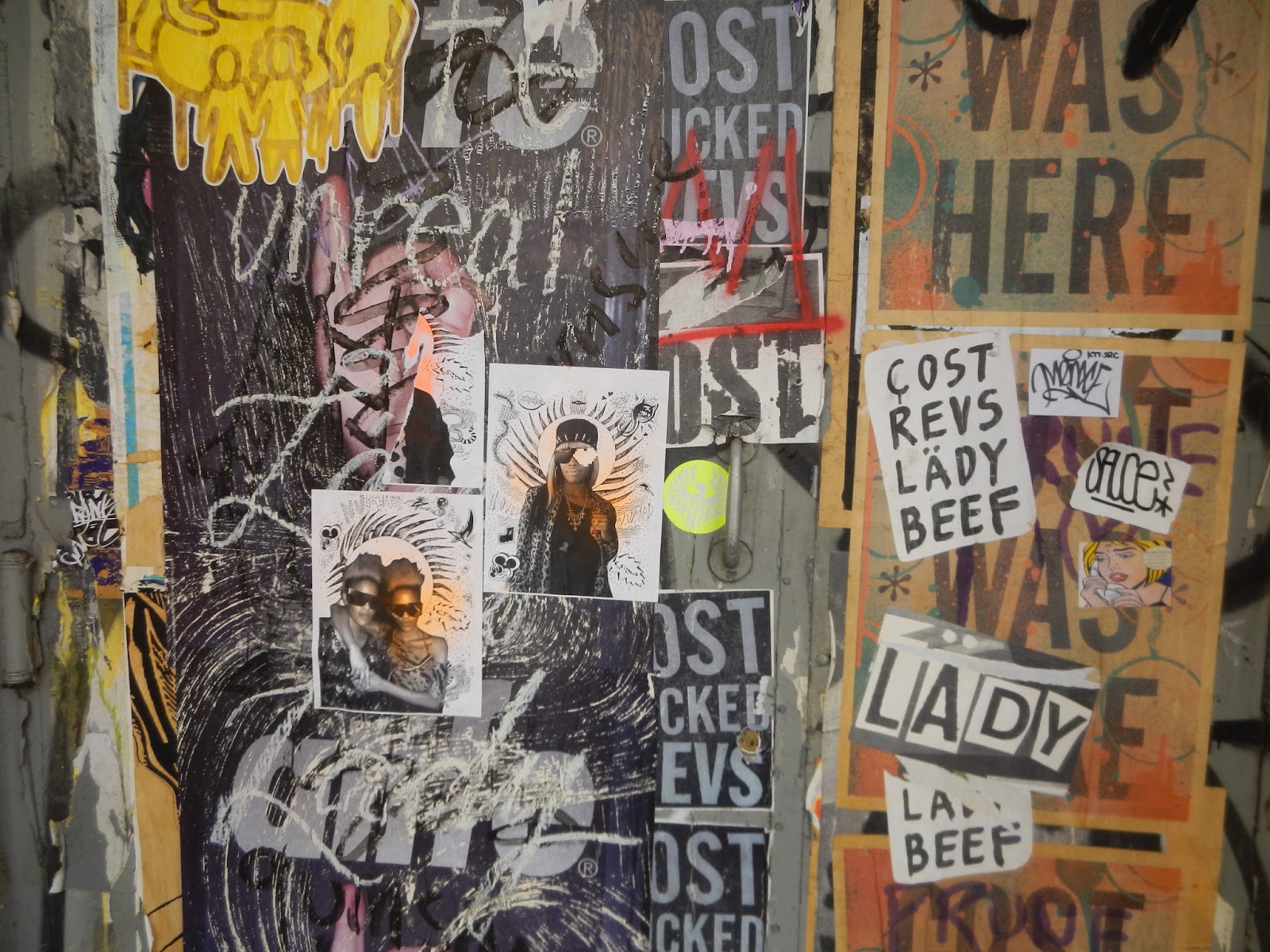
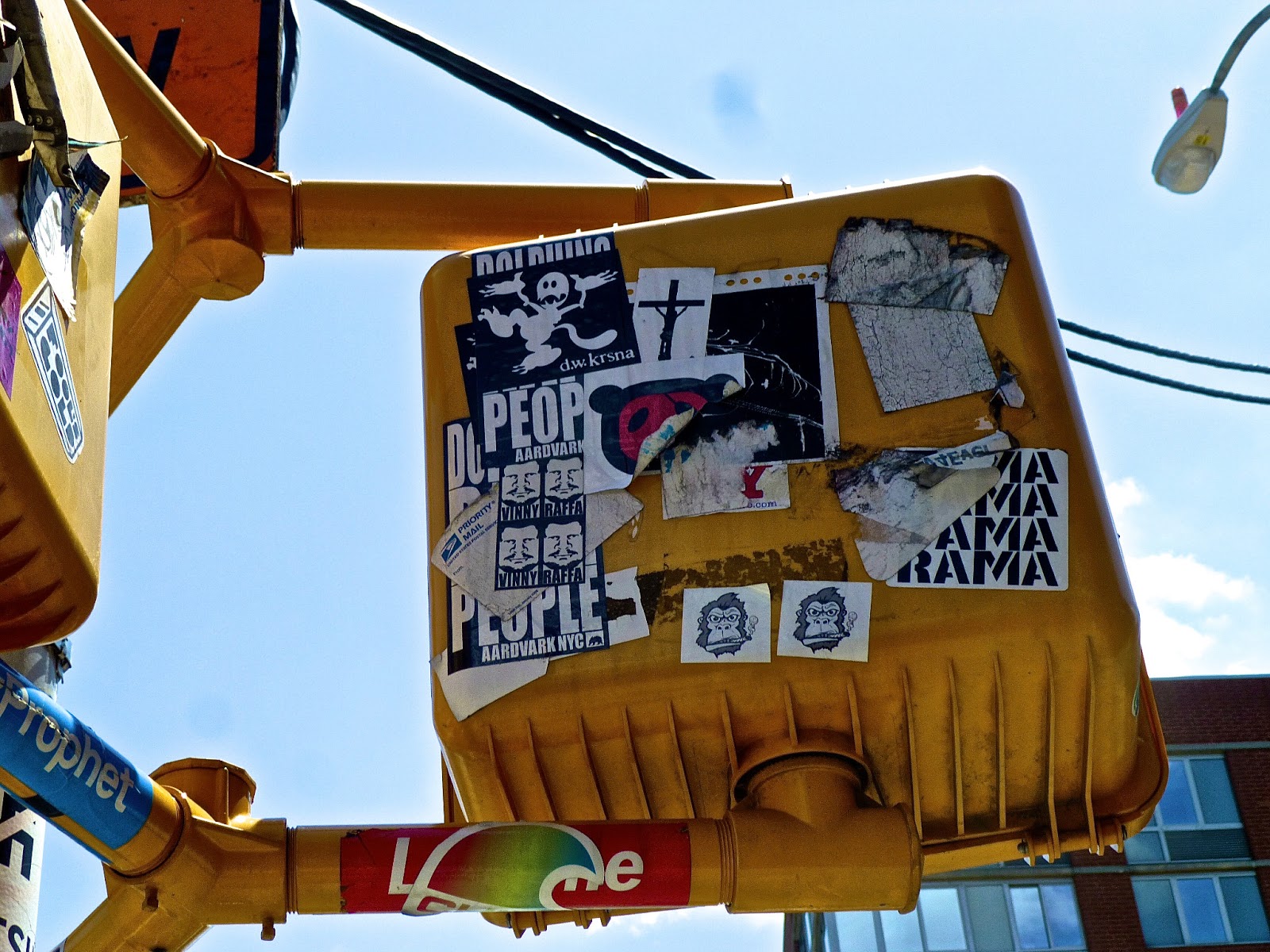
An interesting variation of this street art are the stickers that you could find almost everywhere in Southern Manhattan, on lamp posts, mail boxes, energy transformers and where else.

Stickers are small pieces of paper than be glued placed anywhere accessible. Placing them goes "with a much lower risk of apprehension by officials enforcing anti–vandalism laws", explains Wikipedia (wikipedia). They also report: "Sticker artists can design and print thousands of stickers at low cost using a commercial printing service or at home with a computer printer and self-adhesive labels".


It seems there is a cult around those stickers. There are some websites dedicated to this art form  (streetartstickers  stickerobot).


Stickers have different purpose. Often they advertise something, like an upcoming rock concert. Others display politics, religion and Weltanschauung. Many stickers are just for poking fun and to provoke.


I like them. They make the city more colorful and cool. Some give me something to think about. Often the combination of different stickers forms a pattern - accidental or not. Those collages are an art form by themselves.



To be continued

Enjoy

Thursday, July 4, 2013

Books: New York - The Novel, by Edward Rutherfurd


(Drivebycuriosity) - I like New York and I like to read history books. Hence I purchased a Kindle edition of "New York - The Novel", by Edward Rutherfurd (amazon). The author delivers a mixture of a fiction and non-fiction book. He tells the history of New York City in the shape of episodes about fictional characters living in different time periods since the founding of the metropolis.

This combination didn`t really work for me. I didn´t learn much about the advance of New York City or how she got shaped. The book is more a collection of short stories than a history book.

The narrative structure leads to large chronological leaps - and corresponding gaps - that conceal the big historical picture. It seems that the author was more interested in his fictional characters than in the development of the metropolis. Some of the episodes are well written, but others didn´t interest me. 


For those, who don`t want to bother to read this book but are interested in New York´s development over time, here is a short sketch:

The nucleus of New York City was a settlement on Manhattan, one of the countless islands at the north east coast of today´s USA (wikipedia).  This place belonged originally to the American natives, who are ignorantly and falsely called "Indians" (the same word is used for citizens of the state India thousands of miles away). Dutch settlers coerced the local tribe Lenape to sell them Manhattan for cheap and started there a trading colony on the behalf of the "Dutch West Indies Company", a kind of an early hedge fund.

The colony, called New Amsterdam, flourished thanks to the trade of beaver furs that the settlers bought cheap from the natives and sold them expensively to Europe were they were high in fashion.  In 1664 the English overtook Manhattan and the nearby islands, that became later Brooklyn, Queens, Bronx and Staten Islands (5 Burroughs), and renamed the island group New York.


New York City benefitted from the harbor - protected by a 118 miles long island (today: Long Island) - and the huge Hudson River that allowed shipping right into the almost virginal Northern American continent. The opening of the Erie Canal in 1825, which connected the Atlantic port to the vast agricultural markets of the North American interior, gave the place another boost.

The fledging city also gained from the libertarian and capitalistic spirit inherited from the early Dutch traders and English entrepreneurs including a reliable & efficient legal framework. "The city's cosmopolitan attitude and tolerance of many different cultures encouraged many different types of immigrant groups to settle in the city", reports Wikipedia (wikipedia).


The city´s wealth grew with the booming trade between the fledging colony and Europe: Fur, tobacco, sugar, manufactured goods and - shame on then - slaves from Africa. In the 18th New York City made a lot of money as a leading slave exchange.

New York City benefitted as a major trading place from the American revolution, the civil war and the industrialization of the U.S. because all these events created an enormous hunger for goods.

In the late 19th and early 20th century the city became a world center for industry, finance, commerce and communication. This lead to a huge accumulation of wealth and the rise of gigantic banks and Wall Street. Entrepreneur families like the Rockefellers, Vanderbilts, Guggenheims, Carnegies, J.P. Morgans collected vast amounts of capital and ruled almost their world.

But they also gave most of the reaped profits back. While European public institutions like museums, opera houses and libraries are built with tax money, in New York those places are financed by donations. Today`s New York displays the beauty of the greed: Jewels like Guggenheim Museum, Carnegie Hall, Morgan Library & Museum are just examples for public institutions gifted by donors.


New York city might be seen as one of the most capitalistic places of the world, but the metropolis also got shaped by politicians. Legislators gave most of the city (north of the historic part) a pattern like a chess board with avenues travelling north to south and numbered streets from east to west. Intersections of important traffic arteries became buzzling places like Union Square (5th Avenue and 14th Street), Time Square (Broadway, 7th Av, 42nd Str). Ambitious connections like Brooklyn Bridge (completed 1882), Manhattan Bridge, Williamsburg Bridge, Holland and Lincoln Tunnel also shaped the face of the metropolis.

In the 19th century the city development, especially construction of tenant buildings, got influenced by Tammany Hall, an alliance of unions and the Democratic Party, and in the early 20th century by the so-called power broker Robert Moses who controlled urban planning, including building the majority of the city parks. Fiorello La Guardia, and other mayors, had a large part in the story of New York City of course.


Today NYC is recovering from 2 recessions, super-storm Sandy and 9/11 and is flourishing again as a buzzing and beautiful global center.

Wednesday, July 3, 2013

Oil: Egypt - The Alarm Call

(Drivebycuriosity) - Today the price of oil rose sharply. According to the media the market is responding to the crisis in Egypt. It is said that the turbulences in the North African Country are stimulating fears that the supply of oil from the Near East (the largest oil producer of the world)  could be disrupted. Oil is continuing a rally that already started in April (plus 20% since then) caused by violence in Syria & Turkey that also induced speculation on oil supply disruptions.

The recent oil price rally is an alarm call. It shows that the civilized world is too dependant upon oil supply coming form unruly regions like the Near East. High & rising energy prices are slowing down the already sluggish word economy.

But there is an answer: Fracking. U.S. oil production is rising fast thanks to the new exploration technique. Fracking lessens the U.S. dependency on global oil supply and makes the country more resistant against a geopolitically caused energy shortage.

But there is a lot of political resistance against fracking in the U.S. and even more in Europe. Opponents claim that this technique is endangering the environment. I believe that the risks are manageable thanks to the technological progress. The world needs more oil supply from politically stable regions like the U.S. and Europe. This would curb the economic damages caused by the ongoing speculation on a possible geopolitical oil supply shortage.

Tuesday, July 2, 2013

Movies: Byzantium


(Drivebycuriosity) - To say it frankly: The movie "Byzantium" is the greatest disappointment of the 2013 movie year so far (imdb).

I had high expectations because of the cast and the director Neil Jordan. The movie maker had been one of the godfathers of the "New British Cinema" from the 80s with fascinating films like "The Company of Wolves", "Mona Lisa" and "The Crying Game" and he delivered later the baroque and highly enjoyable "Interview with the Vampire: The Vampire Chronicles".

But it seems Jordan lost his talent. He and his script writer Moira Buffini delivered a half-cocked plot. It looks like that both were unsure what kind of movie they wanted to make. Adding insult to injury: The director didn´t have any proper use for his formidable cast.  Awesome Saoirse Ronan, a rising star in Hollywood´s canopy, wandered aimlessly through a wreck of a plot. Gemma Arterton, who I much enjoyed in "Hansel and Gretel: Witch Hunters" as a super-cool actress, was equally wasted on the ill-crafted film. The same is true of British actor Jonny Lee Miller, who now can been seen as Sherlock Holmes in the U.S. series "Elementary".

The genre has a lot of pearls (recently "Kiss of the Damned" driveby) but "Byzantium" is not one of them.


Monday, July 1, 2013

Stock Market: Year Of The Bull - Part II

(Drivebycuriosity) - The U.S. stock market (S&P 500) gained 12.6% in the first six month of 2013. I reckon that this rally will continue in the second half of the year.

The majority, including the gross of hedge funds, is still too pessimistic and underinvested. Many professional investors (fund managers et.al.) are sitting on high cash reserves. I believe that those bears will get again punished by solid economy numbers that lead to stock market gains.

The global economy, especially the U.S. economy, is better than many expect. The majority underestimates the strength of the US consumer spending. I expect that the U.S. consumers, the engine of the global economy (imports), stay optimistic and continue their spending spray encouraged by the healing job market, the recovery of the home prices and gains on the stock market (income effects).

I also believe that the majority underestimates the robust growth of the company profits which is the main motor of the stock market rally. In the recent months U.S. and European companies have proved that they can generate rising earnings thanks to efficiency gains and the ongoing technological progress.

And many companies are sitting on huge cash piles that enable them to finance further stock buy backs and dividend hikes making stocks more attractive.

I further believe that Europe is turning the curve now. Some early indicators (manufacturing indices) are signaling that the European industry is bottoming out. Germany, the largest economy of the region, already reports growing retail sales.

Solid growth in the U.S. and an European recovery in the second half of the year could reaccelerate growth of the still very export dependent Chinese economy which disappointed in the first half of the year.

Hence I expect that the S&P 500 will gain in the coming six months another 10% plus and could close north of 1.800 by the end of the year.

Culture: Gay Pride Parade 2013, New York City


(Drivebycuriosity) - New York is a colorful place. Yesterday the metropolis got especially flamboyant: Manhattan had her annual Gay Pride Parade.

Following the tradition a sheer endless stream of reveler marched down 5th Avenue to Christopher Street in the "West Village". This year they jubilated the decision of the Supreme Court to grant same-sex couples federal marriage benefits.


Many thousands participated in the parade and as spectators along the march. You could spot lots of extravagant costumes, but also a lot of skin.

The parade was heavily commercialized. There were advertisements for Citi, Chase, Whole Foods Market and many more big companies. And the contenders for this year´s New York City mayor election participated in person or were represented by their fan groups.


Even the weather participated. It got steamy and a bit wet.

I am looking forward to next year´s Gay Pride Parade.

Gold/Commodities: Welcome Back, Rationality

(Drivebycuriosity) - Last quarter the gold price tanked around 23%. The yellow metal lost more than 35% from its peak in September 2011. It seems the gold bubble is finally popping. Welcome back, rationality.

Gold is not an investment. Hoarding money in gold is unproductive. The yellow metal doesn´t generate dividends & interest like stocks, bonds and real estate. The gold rally of the recent years was just a kind of mass hysteria. Some were betting on doom & gloom and another recession or a new depression. Other wagered on a hyper inflation. Those bets didn´t make sense because depression and hyper inflation are contradictory.

The falling gold prices since September 2011 signal that the hysteria is abating and the markets are coming back to sanguinity and rationality. There is neither a risk for a depression nor a hyper inflation thanks to the stabilizing monetary policy of the U.S. Federal Reserve Bank.

The popping gold bubble is good for the economy and the stock market. The billions of dollars that had been idled in the yellow metal is now free. This money could pour into the economy and into stocks leading to more economic growth and a further rise of the stock market.