Friday, September 21, 2018
Contemporary Art: A Scratch In Time @ Thierry Goldberg Gallery New York
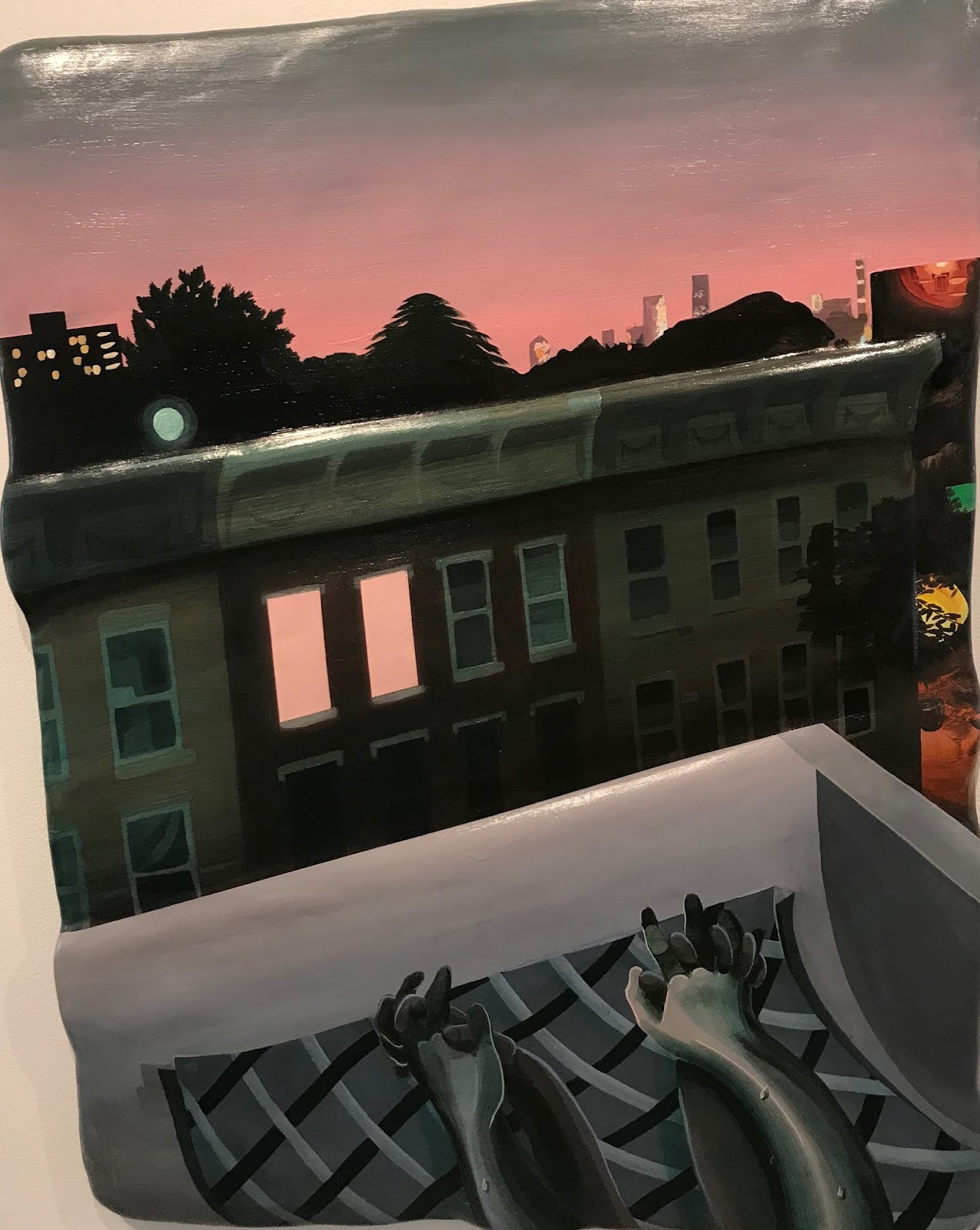
This week I saw there again an interesting group exhibition - called "A scratch in time" (through October 7, 2018 thierrygoldberg ). I display here my favorites, a very subjective selection as usual. Let the images speak for themselves.
Above you can see two images by Grace Metzler: "Lovers Quarrel + Make Out" (2018, oil and acrylic on canvas, 48 x 60 inches) & "The end of Summer" (2018, oil and acrylic on canvas, 60 x 60 inches )
Above 2 images by Kelly Beeman: "Life Guards" (2018, watercolor, ink, colored pencil on paper, 22 x 30 inches) & "Singing at the Piano" (2018, watercolor, ink, colored pencil, gold ink on paper, 30 x 22 inches).
Above images by Kyle Vu-Dunn: "Bad News (II)" plus "In the Garden" & "Rooftops", all 2018, Acrylic on resin, plaster, and foam panel.
Above 2 sculptures by Derek Weisberg: "Perfection at Every Moment" (2017, cone 6 ceramic and mixed media, 34 x 13 x 11 inches) & "A Phoenix Wishbone" (2018, porcelain, 34 x 14 x 12 inches).
To be continued
Thursday, September 20, 2018
Books: The Year`s Best Science Fiction - 35th Annual Collection By Gardner Dozois
I just finished reading his "Thirty-Fifth Annual Collection" which harvests the science fiction year 2017 (the paperback edition, published in July 2018, has 720 pages amazon). As usual Dozois starts with a lengthy summation of important events, trends and publications in the world of science of fiction in 2016. For each story the author wrote an introduction where he outlines the background and most important works of the presented author.
The collection of 39 stories by different authors has something for almost everyone. I found 12 very strong stories at least, a good quota. I enjoyed the space operas, especially "Night Passage" by Alastair Reynold. The plot is told in first person by the female captain of a space ship. She has to deal with a sudden and unexpected stop on an interstellar flight which causes a dangerous situation. Who did it and why? How to escape the danger? One of the best space operas I have read recently, thrilling and spiced with science. Reynold is a professional scientist with a Ph.D. in astronomy who had worked for the European Space Agency in the Netherlands but belongs now to the most successful sci-fi writers. I also like "The Wordless" by Indrapramit Das, another space opera set on a planet which is used as a transit station for bizarre spaceships. Indian philosophy meets ultra-high tech - very exotic.
I loved the stories about the wonders of technological progress. My favorite there is "A Series of Steaks" by Vina Jie-Min Prasad. The tale is set in a near future Hong-Kong and focuses on Helena, who sees herself as an artist. Helena has an university degree and tries to make a living by producing fake steaks with the help of 3D-Printers, which is strictly illegal and brings her into deep trouble. The story is fresh & original, certainly one of my favorites in this book, I want to read more by Jie-Min Prasad. I was also impressed by “Vanguard 2:0.” by Carter Scholz. An astronaut is working in a space station owned by Uber. He is ordered to capture a historical satellite which is still circling around the earth. "Vanguard" is a philosophical story about technology, corporation power and political influence
Gardner covers artificial intelligence (AI) of course, maybe the most important sci-fi topic of the present: "Zen and the Art of Starship Maintenance" by Tobias S. Buckell is told in first person by a robot with artificial intelligence who does maintenance works on the hull of a space ship. He has to deal with a superior power which causes a conflict of interests. Very subtle and thought provoking. "Number Thirty Nine Skink" by Suzanne Palmer is also told in first person by a robot with artificial intelligence. This AI has the mission to terra-form a freshly discovered planet which leads to surprises.
The collection also deals with alternate history/worlds: “Winter Time Sharer” by Ray Nayler focuses on very special tourists who are visiting a future Istanbul. There is not much happening but I enjoyed Nayler´s style and the atmosphere he creates.
Dozois also covers Cloning: In "Triceratops" by Ian McHugh scientists have cloned Neanderthals which causes social tensions.
And there are aliens as well: In "Canoe" by Nancy Kress scientists are exploring a moon in a distant sun system and are confronted with a cosmic issue.
Gardner covers other interesting topics of course: "The Proving Ground" by Alec Nevala-Lee deals with global warming. The story is set in near-time future on an atoll in the South Pacific. Residents and scientists from abroad are trying to adapt the island to the rising sea level. A sophisticated story about evolution, technology, international law & more with influences by Alfred Hitchcock´s "Birds". “My English Name” by R.S. Benedict is set in contemporary China and told in first person, but not by a real person. An entity is faking to be a human being (changeling), but has problems doing so.
“An Evening with Severin Grimes” by Rich Larson focuses on a billionaire who got abducted by a group of radical terrorist. A slick near-future thriller
Sadly this is the last edition of these wonderful collections. Gardner Dozois died shortly before the publication. Fortunately many of the 35 editions are still available as Kindle books, for about $10 and less.
Tuesday, September 18, 2018
Science: Animals Behave Rationally & Follow Their Self Interest, Why Can`t People? - A Defense Of Economics
(Drivebycuriosity)
- It seems that economics is out of fashion. Economists assume that people are rational & follow their self-interest. They claim that humans behave economically because their resources - time, food, land, money etc - are limited. Many pundits disagree and declare economics as useless. Last year Prof. Richard Thaler, one of the loudest deniers of economics, received the Nobel Prize for economics!
But dolphins don´t care about Nobel Prizes and they ignore the pundits. The "Guardian" describes the rational behavior of Kelly, a dolphin, who lives in a research institute in Mississippi ( theguardian):
"All the dolphins at the institute are trained to hold onto any litter
that falls into their pools until they see a trainer, when they can
trade the litter for fish. In this way, the dolphins help to keep their
pools clean. Kelly has taken this task one step further. When people drop paper
into the water she hides it under a rock at the bottom of the pool. The
next time a trainer passes, she goes down to the rock and tears off a
piece of paper to give to the trainer. After a fish reward, she goes
back down, tears off another piece of paper, gets another fish, and so
on.
…Her cunning has not stopped there. One day, when a gull flew into
her pool, she grabbed it, waited for the trainers and then gave it to
them. It was a large bird and so the trainers gave her lots of fish.
This seemed to give Kelly a new idea. The next time she was fed, instead
of eating the last fish, she took it to the bottom of the pool and hid
it under the rock where she had been hiding the paper. When no trainers
were present, she brought the fish to the surface and used it to lure
the gulls, which she would catch to get even more fish. After mastering
this lucrative strategy, she taught her calf, who taught other calves,
and so gull-baiting has become a hot game among the dolphins.
The dolphins are not only gaming the system they are saving and using a capital structure to increase total output".
The Rules Of Supply And Demand
Kelly certainly behaves rationally. The dolphin is spending energy & time to get more food, a strategy which is called profit maximizing. And dolphins aren`t alone. Researchers from the Max Planck Society discovered that at least some birds, the African Grey Parrots, also are rational and follow their self-interest (phys.org). They report:
"The birds have learned how to trade a token for food: one each for a low, medium or high-value food. The task was to choose between an instant food reward and a token that they could exchange for higher quality food. In controlled tasks, however, selecting a token resulted in an equal or lower payoff. The parrots only rejected the immediate reward and chose the token, if the token's value corresponded to a higher quality food compared to that of the immediately accessible food. The results show that parrots are capable of deliberate and profit-maximizing decisions."
Animals also respond to rising prices and consume less of something when it gets more expensive. Animals don´t use money of course, but they pay by burning energy and spending time to get some preferred food. The Dictionary of Animal Behavior says, if an animal expends a certain amount of energy on a particular
activity, then it usually does less of that activity if the energy
requirement is increased (oxfordreference). Studies show that animals invest in auspicious assets the same way stock market investors do. Researchers from the University of British Columbia and Warsaw
University of Life Sciences found that dairy cows are willing to expend
energy (for instance for opening a gate) to gain access to a grooming brush (phys.org).
Scientists are observing "biological markets" where animals trade goods (food) and services (grooming, shelter, protection etc.), following the economic rule of "supply and demand" (ronaldnoe). For instance 'helper wasps' raise the offspring of dominant
breeders in small social groups in return for belonging in the nest (sciencedaily). Scientists from the University of Sussex noticed that "the helper wasps provide less help to their own 'bosses' (the dominant breeders) when alternative nesting options are available. The dominant wasps then compete to give the helper wasps the 'best deal', by allowing them to work less hard, to ensure they stay in their particular nest".
I don`t assume that animals think. They follow their instincts which are shaped by evolution. If a species would behave irrationally it would lose against their competitors (getting less food and inferior shelter for instance) and would have gone extinct over time. The best strategy wins and their genes survive. This way animals inherited behavior which leads them to act economically.
If animals can behave rationally and follow their self interest, why don´t people? Prof. Thaler is wrong and does not deserve a Nobel Prize for economics.
Sunday, September 16, 2018
Contemporary Art: Amazing Trompe L’Oeils @ Marc Strauss Gallery New York
(Drivebycuriosity) - The art world is full of wonders. Some of them I spotted at Marc Strauss Gallery on 299 Grand Street, New York`s unofficial borderline between the Lower East Side and Chinatown (marcstraus). The art dealer is now showing work by the Spanish artist Antonio Santin (through October 16, 2018).
Above "Cajón Desastre" (2018, Oil on Canvas, 70.8 x 78.7 inches (180 x 200 cm) plus a detail shot.
Above "Debris a vis" (2018, Oil on Canvas, 75 x 118 in (190.5 x 299.7 cm) and a detail shot.
To be continued
Friday, September 14, 2018
Stock Market: Ignore Morgan Stanley
First, nobody can foresee the future. Stock market movements are unpredictable. If banks were better in guessing the economy & the financial markets, they would not have to be saved in the 2008 crisis. But we can think in probabilities. There are many catastrophes possible: The world could get hit by a major meteor, volcanic eruptions could cause a nuclear winter, a global epidemic could kill many millions etc. Fortunately the likelihood for these events is very low - and so is the probability for a stock market stagnation over the next years.
Stocks Follow The Company Earnings
Morgan Stanley claims that the current bull market, which hiked stock prices more than 300% since spring 2009, is fueled by an expansive monetary policy, meaning low interest rate rates and bond purchases, which is now coming to an end. But the monetary policy is just a part of the story. Since 1950 the S&P 500 rose on average annually 6.7% , even that dividends are not included (annually 2-3% driveby), faster than the economy, which grew 2 - 3% annually, because stocks follow the company earnings, which are rising much faster than the economy.
Rising company profits are the engine of the current bull market and are responsible for the more than 300% gains. This year US company profits are rising more than 20%. Even without the tax cuts by the Trump administration they are climbing more than 10%. The growing profits are keeping stock valuation (price-earnings-relations) reasonable and are overcompensating the negative effect of climbing Fed interest rates.
I assume that company earnings will continue to grow with double-digit rates because fast rising company earnings are a long term trend. Corporations are getting more efficient & more productive over time - thanks to learning processes and the technological progress. They are learning organisms because they are managed by humans who are continuously improving themselves and their companies. During the recession 2008 companies had restructured and reduced costs significantly in order to survive. Now they are more fit & more efficient than before.
Company earnings are also boosted by automation. Since the early 18th century (the first industrial revolution) the technological process has been enabling companies to produce more goods & services with the same amount of employees. More and better machines are doing the work of people which translates into lower costs, higher profit margins and climbing earnings.
It seems that this process is accelerating again and we are at the begin of new industrial revolution. We are experiencing a rapid advance of information technology, meaning combinations of computers, smartphones, Internet and other digital systems. Software - which is increasingly Internet connected and uses more and more the cloud (access to huge external data centers) - organizes the whole business: Creating new products, inducing machines to run more efficient, finding cheap suppliers, manage customer relations and so on. Car producers and many other manufacturers are increasingly using robots and similar machines to reduce their costs. Companies are also beginning to use 3D-printers to become more cost efficient and flexible.
Ignore Morgan Stanley.
Thursday, September 13, 2018
New York City: David Salle On Fifth Avenue
To be continued
Wednesday, September 12, 2018
Contemporary Art: Chinese Expressionism @ Chase Contemporary New York
(Drivebycuriosity) - China is rising. The huge country is not only gaining economic power, China is also getting more important in the world of art. At Chase Contemporary in Manhattan´s Chelsea district (521 West 23rd Street I spotted fascinating large murals by the Chinese artist Liu Shuishi (through October 13, 2018 exhibitions).