Saturday, October 12, 2013

New York City: De Blasio - The Wrong Choice

(Drivebycuriosity) - Soon New York City will have a new mayor. It looks like that Bill De Blasio will be the successor of current mayor Michael Bloomberg. The politician is the candidate of the Democratic Party, which has the majority (68%) of New York`s registered voters and therefore a high chance to win the final election. Recents polls show that De Blasio has a wide lead over the Republican Joe Lhota in the race for New York City mayor (wsj).

If De Blasio would indeed become New York`s next mayor this would be the wrong choice. According to the New York Times De Blasio is the "most liberal" of the "Democratic" candidates who had been fighting for the candidateship in the preliminaries (nytimes). In other words  De Blasio is most leftist of all "liberal" candidates. Some media call him a left-wing populist (newgeography).


Indeed De Blasio led a campaign which was polarizing and spiced with left leaning rhetoric: “Government must focus on the needs of families, must be the protector of neighborhoods and must guard the people from the enormous power of moneyed interests" (politicker). This reminds me of the propaganda of the communist party in the defunct GDR (German Democratic Republic = East Germany)

A central part of his strategy is his  “tale of two cities". In his book “One New York, Rising Together” he claimed: "Nearly 400,000 millionaires call New York home, while nearly half of our neighbors live at or near the poverty line. Our middle class isn’t just shrinking; it’s in danger of vanishing altogether" (nypost).
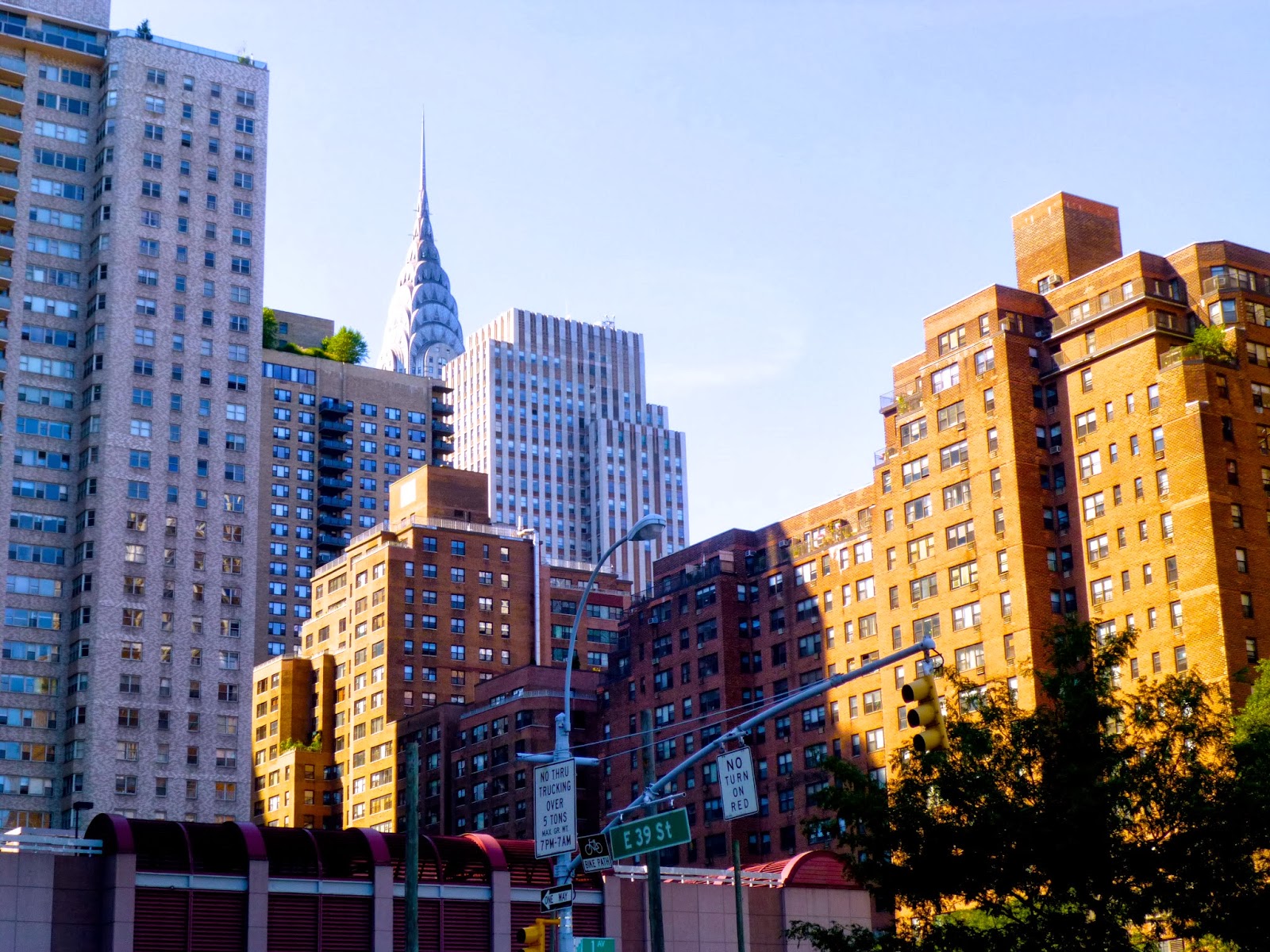


Really? A vanishing middle class? The streets, shops and restaurants of Manhattan - and parts of Queens & Brooklyn - show a different picture. They are crowded with affluent people who are capable to spend money. As you can see New Yorkers in general all well off. And even the rich are creating jobs, revenues and tax income by spending money in shops, restaurants and bars.

The site "NewGeography.com" writes, that many business people rightly fear that De Blasio’s administration will raise taxes in order to meet public employee demands (newgeography). Recently he talked about lifting the tax for the rich to create revenues. In a recent interview the liberal candidate also defended his support for Nicaraguan Sandinista and Fidel Castro`s Cuba (politicker). 

De Blasio´s populist rhetoric reminds me of the French politician François Hollande. In 2010 this candidate of the Socialist Party won the French elections by "throwing red meat to the left", writes the Economist (economist). Hollande used populistic leftish arguments like raising taxes on big corporations, banks and the wealthy and bringing the official retirement age back down to 60 from 62. He also pledged for creating subsidized jobs in areas of high unemployment for the young and promoted more industry in France by creating a public investment bank. Hollande`s policy has been bad for France`s economy because it is weakening private initiative and slowing down investments in capital. Today France is the weakest part in Europe (except Greece). While the rest of Europe (except Greece) is on the upswing again France fell back into recession and unemployment is on the rise.


The major of a city can do less harm than a president of a country, of course. The mayor of New York City has not just to deal with the federal government in Washington. D.C, he also has to respect the New York State government in Albany. But he could increase spending which could lead to higher debts and raise local taxes. The bankrupt of Detroit, ruled by left-wing politicians, in spite of the return of the U.S. car industry is an example how a bad management can destroy a city.

Part of De Blaso`s campaign also is his  critique of the stop and frisk program of the New York police department that was encouraged by the Bloomberg administration. This active police strategy is a success story. Today the east coast metropolitan is one of the less riskiest cities in the U.S. and much safer than in he 1970s and 1980s. An alert police strategy reduces the risk to get mugged and assaulted on the streets. Does New York really want a return to the 70s as gangs ruled the streets? Does the City really need to follow Chicago where a lax policy by liberal mayors invited new gang wars on the street?


New York City did well under Bloomberg. The metropolis came back after the 9/11 trauma, the financial crisis of 2008/09 and superstorm Sandy. Today the city is a prospering global metropolis again.

New York City strived for around 3 centuries and rose to one of the leading global centers because of the business friendly climate. For 3 decades "Gotham" has been attracting finance, media, fashion, technology and other industry, all creating jobs, revenue and tax income. The metropolis also is a magnet for global tourism and international business travel. A business unfriendly policy and a rising criminality could scare off companies and visitors.

New York is competing against other global centers like London, Shanghai and more. It is also challenged by U.S. places like Los Angeles.  New York has bad winters, it doesn´t need a bad mayor.

Economy: Why A Tax On Junk Food Would Reduce The Costs Of Healthcare


(Drivebycuriosity) - There is a lot ado about Obamacare and the huge costs of this program. According to the World Bank the U.S. currently spends 17.9% of its total GDP on health services (), much more than Canada (11.2%), France (11.6%), Germany (11.1%) and UK (9.3) (worldbank). Experts claim that Americans are less healthier than Canadian, French, Germans and Britons and spend therefore more money for curing diseases.

I believe that the bad health (and the resulting high health care costs)  of the average American is at least partly caused by the American crave for junk food: hamburgers, sandwiches, chocolate bars, ice cream and other foods which contend a lot of sugar & fat - plus over sugared soft drinks.

Many ignore that the heavy consumption of junk food & soft drinks could cause diseases like heart attacks, strokes and cancer. The costs of the medical treatment of these diseases are often borne by insurances, meaning by all their members (customers).


Economists call this behavior "moral hazard": People care less about risks if their consequences are borne by others (wikipedia). The heavy consume of junk food is just another case of "moral hazard".

Economist also know a solution for the "moral hazard" problem: Taxes. In many countries alcohol & tobacco carry high taxes because those products cause medical costs which are borne by insurances. Europe also has high taxes on gasoline because of the environmental problems.

I suggest a special tax on junk food, ergo on food that is high on fat and sugar. The tax income could be used to finance health care costs caused by over-consumption of sugar & fat. 


I reckon such a tax would be fair because otherwise insurances (and all their members) have to pay for such costs. Such a tax also could reduce the costs of Obamacare.  

A fast food tax also might  lead to a healthier behavior and less consumption of junk food.


China Pessimism Bubble: Don´t Trust The Headlines - October 2013 Edition

(Drivebycuriosity) - The media still don´t get China. The headlines this morning focus on China´s export numbers that have been reported last night. In September overseas shipments dropped 0.3 percent from a year earlier (bloomberg).

The media played down that China simultaneously reported solid import numbers. China´s imports rose 7.4% last month from a year earlier (yahoo). This week we also learned that in the past weeklong National Day holiday Chinese retail sales climbed 13.6% compared to last year.

I reckon that the import & retail numbers tell as much more about the state of the Chinese economy than the erratic export numbers. The advancing imports & retail sales reflect the fact that China´s domestic economic is still on a fast growth track. Both numbers are an indication for a solidly growing domestic consumer demand that is reducing China´s dependence from the the volatile export markets, making the economy more robust and healthier.

I reckon that the headlines are a tribute to the ongoing china pessimism bubble that is still ruling media & investors (driveby). The gloomy sentiment is holding back the Chinese stock market and creates ample investment opportunities in the Middle Kingdom.

Friday, October 11, 2013

Movies: Gravity


(Drivebycuriosity) -  Floating through outer space is an old human dream. In the year 1961 the Russian cosmonaut (astronaut) Yuri Gagarin realized this idea as the first human. Since then we have learned a lot about the beauty of space travel but also about its perils. The movie "Gravity" might be the first film that lets us experience awe and horror of space travel while sitting in a cinema theater (imdb).

The debris of a Russian satellite, which is now circling around the earth, destroys an American space station and endangers the life of the astronauts who are working there. This starts a chain reaction with disastrous consequences. 

Director Alfonso Cuarón, who also was co-writer, co-producer and editor of "Gravity", shows what modern cinema is capable to. The audience gets sucked into a cinematic maelstrom thanks to cutting-edge special effects and advanced 3D techniques.

I indulged the sheer beauty of the earth seen from space, enjoyed watching sunrises and sunsets and the gorgeous stars and relished the almost realistic impression of weightless floating, the absence of gravity. But I also shared the claustrophobic horror caused by the catastrophe in the vacuum of outer space. Some scenes are somewhat funny when things are floating around you - thanks to the gorgeous 3d-effects, other scenes convey a kind of meditation.

Even though "Gravity" stars Sandra Bullock and George Clooney, the film is almost an one woman movie. Most of the time the audience follows magnetized Sandra Bullock who's character reminds me strongly of Sigourney Weaver in Alien. 

The role also brings Tom Hanks performance in "Cast Away" to my mind. The actress did a brilliant performance which animated the audience to sympathize with her character. He appearance was very convincing and gave the film sometimes an erotical note.

"Gravity" is a must see and a strong contender for at least 2 or 3  Oscars.

Global Economy: Who Needs America Anymore?

(Drivebycuriosity) - When America sneezes the rest of the world gets pneumonia. Right? Wrong. It looks like that the U.S. is closed now. At least the American government is shut down - the 10th day now. But the world doesn`t care. Stock markets in Europe & Asia have been defending their strong gains, even the U.S. stock market is close to its all-time high.

Rightly so. China, already the second strongest economy of the world, is gathering speed again. In the past weeklong National Day holiday Chinese retail sales climbed 13.6% compared to last year. The strong domestic consumer demand reduces China´s dependence from the the volatile export market and from sales to U.S.  Europe also is gathering speed as several indices show.

The tailwinds from China`s & Europe´s recovery are lifting the global economy and compensating the impacts of the moronic skirmishes in Washington DC. Who needs America anymore?

Thursday, October 10, 2013

Books: "Molecules" - The Science Behind Breaking Bad


(Drivebycuriosity) - Finally, my favorite TV series - maybe everybody´s - had come to an end: "Breaking Bad". The rise & fall of a chemistry teacher, who uses his scientific knowledge for his rogue career, rekindled my interest in chemistry. Therefore I reread  "Molecules. A Very Short Introduction " by Philip Ball (amazon). The short book (around 150 pages), which is very easy to read, presents the science behind "Breaking Bad" and describes what chemists are able to do today and what we could expect in the near future. This post gives just an outline of the densly written publication.

According to Richard Feynman, one of the leading thinker in quantum physics, the chemist does "a mysterious thing when he wants to make a molecule. He sees that he has got that ring, so he mixed this and that., and he shakes it, and he fiddles around. And, at the end of a difficult process, he usually does succeed in synthesizing what he wants".

Ball defines molecules as "collectives of atoms, firmly welded together into assemblies that may contain anything up to many millions of them". For centuries chemists have been learning to brake those groups apart,  regroup them and to rebuild them, giving them a new shape. "And they are getting rapidly better at the craft of molecule building", claims Ball.

Molecules are in almost everything and concern with most parts of our life. The tiny book covers an impressive variety of topics in just 7 chapters with an average length of 20 pages. Here some examples:


Chapter 1 opens our eyes for molecular science, the basics of chemistry. Ball describes the difficulties to "see" molecules, because they are smaller than the wavelength of light. Helpful are the laws of quantum mechanics (concerning the behavior of electrons and other particles of atoms) that "enable us to predict how atoms will form bonds (with other atoms) and where they will sit in relation to one another". For chemists it is important to know that " atoms of each element have a tendency to form a fixed number of bonds….Carbon atoms prefer to form four bonds, hydrogen atoms just one. Oxygen atoms form two".

Chapter  2 introduces the reader into organic chemistry. Ball quotes the British biologist J.B.S. Haldane who said: "Life is a pattern of chemical processes". The author writes about different kinds of proteins, for instance enzymes, which are molecules that catalyze processes of chemical change. Ball further elaborates about the various functions of molecules  in our body.

Chapter 3 throws a light onto the interaction of molecular science with material engineering. The author describes how chemists construct new materials. "Chemists now know many tricks for engineering particular properties into their materials - making them hard or soft, say, or capable of forming tong fibers". Chemists try to copy nature, for instance spiders who produce very stable fibers (silk) for their web.

Ball claims that one day molecular engineering will make it possible to grow a new kidney. He also confronts the reader with new developments, like carbon nanotubes. These are molecules based on carbon atoms which could lead to extremely stable materials.

Chapter 4  deals with the importance of molecules for energy generation in cells and therefore for our life. Balls describes for instance the photosynthesis of plants and the complex processes how our body burns sugar.

Chapter 5 shows how muscles work with the help of proteins that are acting as molecular machines. Ball also touches the issue of nanotechnology and attempts to construct motors on a molecular scale.

Chapter 6 dives into the mysteries of molecular communication. A diverse array of molecules serves as messengers, that are called neurotransmitters, such as serotonin and dopamine. To this family belong hallucinogenic drugs such as LSD and mescaline that overexcite the brain by enhancing the stimulatory effects of serotonin. Part of these psycho stimulants is Walter`s crystal meth (methamphetamine), but I didn`t find it mentioned in Ball`s book.


In the final Chapter (7) Ball toys with the idea of molecular computers and presents the theoretical concept that computing can be conducted using DNA.

"Molecules" benefits a lot from historical examples and frequent quotes of literature.

Wednesday, October 9, 2013

Stock Market: Government Shutdown - The Wisdom Of Ben Bernanke

(Drivebycuriosity) -  The stock market is under pressure these days. The mess in Washington DC - the pathetic government shutdown and the stupid fight about the debt ceiling - creates a stress situation. But stock prices retreated just 4% from their all-time high so far. This shows the wisdom of Ben Bernanke and his Federal Reserve Bank.

On September 18th Bernanke announced that the central bank will continue their stimulus program QE3 for the time being, meaning that the across-the board expected tapering got postponed.  I was surprised because I believed that QE3 wasn´t necessary any more. The global economy is getting stronger because economic growth in China & Europe is gathering speed and the U.S. economy has been continuing their solid advance (weekly jobless claims are back on the level from 2007).

But now can see how smart the Fed decision was. The taper - in combination with the pathetic Washington D.C. mess - would have doubled the stress for the stock market and could have send stock prices far south. A sharp stock market correction could have created a negative wealth effect because many Americans are invested in the stock market. Therefore a sharp drop of the stock market could have caused them to spend less. It also could have induced companies to invest less into capital and to hire less people. The postponed tapering avoids this additional pressure and is therefore smoothing the development of the stock market.

It looks like Bernanke has foreseen the critical political situation and therefore delayed the taper.