Saturday, May 10, 2014
Culture: Mogwai @ Terminal 5, New York City 2014
The concert - which lasted around 2 hours - was one of the most intense rock experiences I`ve had since I watched a Pink Floyd concert (with founding member Syd Barrett) in London`s Ufo Club decades ago (the other was a performance by Cut of Luna last year driveby ).
Wikipedia labels their music as post-modern, whatever that means (wikipedia). The five musicians (3 guitars, keyboards & percussion) delivered mainly instrumentals, illustrated by some sporadic vocals. The audience got long pieces with some very melodic and atmospheric parts speckled with violent & furious elements with blurred guitars, viscous resonances, feed backs and other effects.
Watching the concert was like walking in a magical garden inhibited by fairies and unicorns - and then suddenly there was an explosion turning the music into massive waves of heat. Then you could physically experience the concert. Amplified by staccatos of bright light (stroboscope flashes) the music felt like matter hitting anti-matter turning into pure energy.
Wow. Thanks a lot Mogwai. We want to see you again!
Friday, May 9, 2014
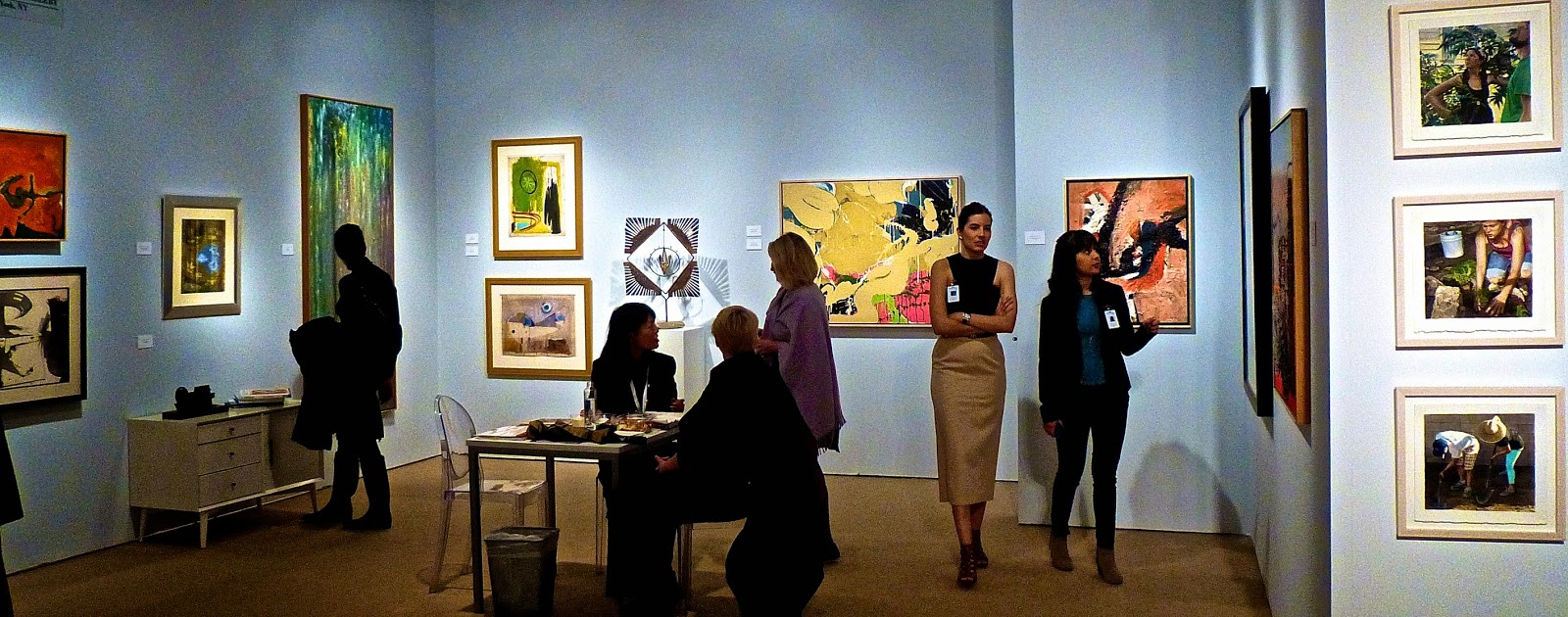
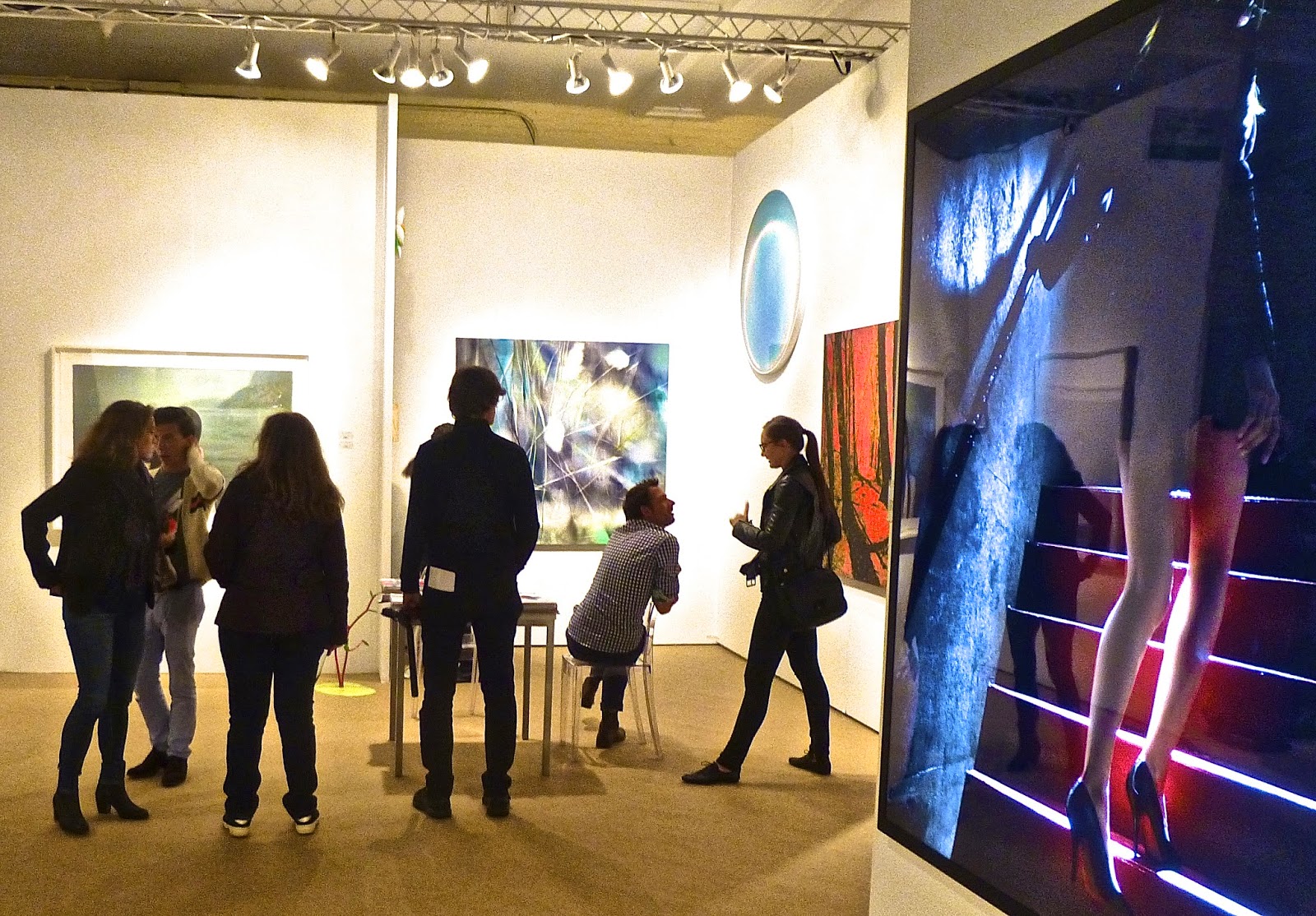
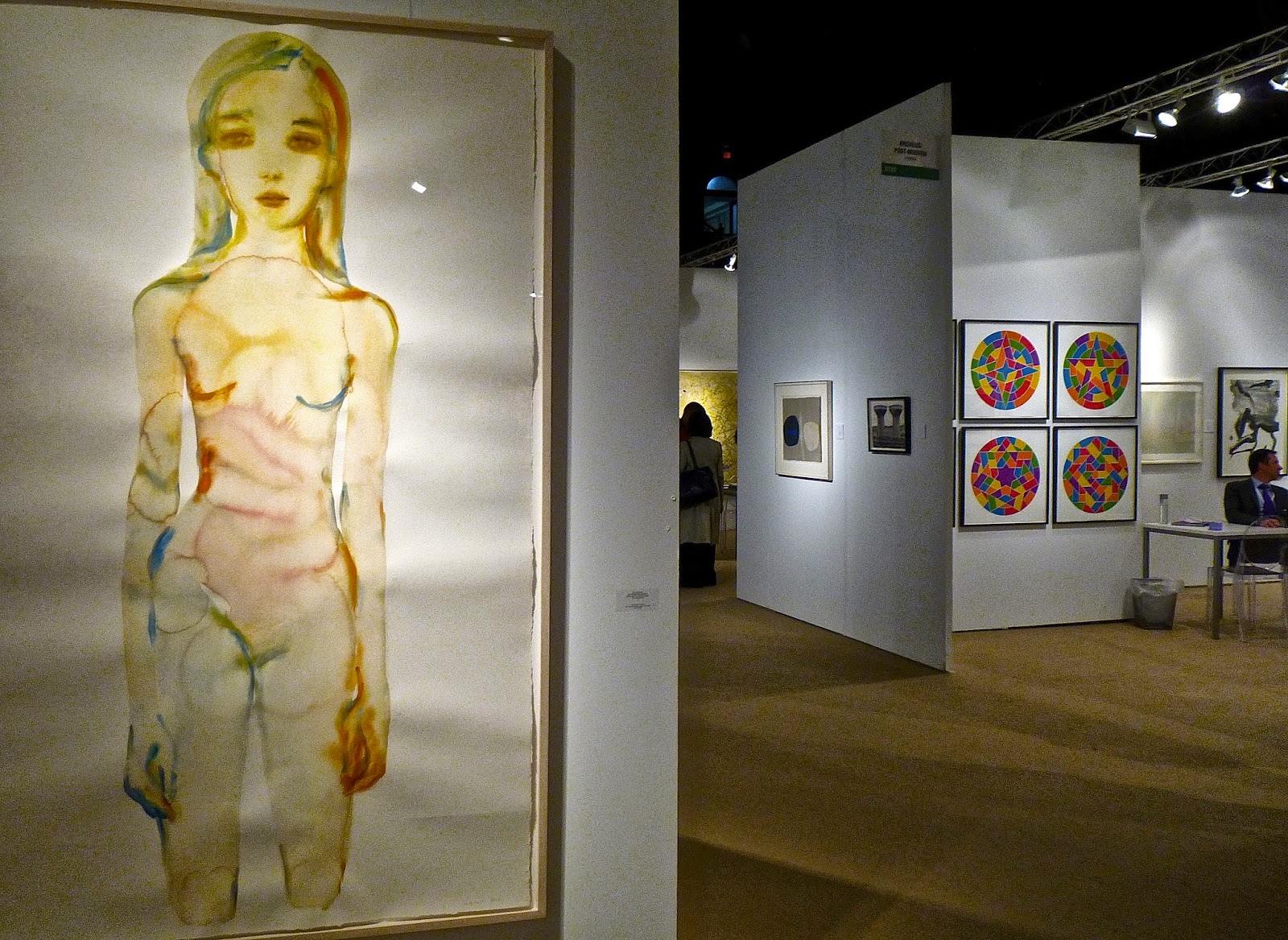
Culture: Downtown Fair - Modern + Contemporary Art, New York City, May 2014
Yesterday I visited the "Downtown Fair" @ Downtown Armory, a place in the Flatiron District, Manhattan (downtownfair). The host also produces the famous art fair "Art Miami". The show runs through Sunday May 11 (General Admission 12pm-6pm).
It was much fun. According to the host´s website nearly 600 artists from over 35 countries are on display. The show focuses on "modern and contemporary works" (no idea what is the difference).
I saw works by established artists like Warhol, Lichtenstein & Botero but also from unknown and uprising creators. I was impressed by the diversity, flamboyance and briskness of paintings, collages, video images and sculptures.
As usual, the event drew an interesting crowd of art collectors, spectators & bohemians. Watching them was almost much as fun as viewing the paintings and sculptures.
Here is a collection of my favorites. Let the pictures speak for themselves. Enjoy!
Tuesday, May 6, 2014
Culture: Wine - In Praise Of The New World
(Drivebycuriosity) - Wine is pleasure, wine is culture. Like (almost) everything which is fun, wine drinking can get very expensive. Especially the French produce could slurp your budget, if you don´t belong to the happy one percent. I believe French wines are overpriced; you have to pay for the grand name and the French are very good in marketing themselves.
Therefore as a wine drinker and buyer I prefer the New World - North & South America plus Australia. There you can get comparable qualities for a much lower price because you don`t have to pay for the prestige. Fortunately the New World offers a huge diversity. There are many ambitious vintners, often with European pedigrees, who grow fine wines. Even Canada delivers some delicious wines. And the huge US has many regions which are suitable for wine growing.
I am a huge fan of the oaked Californian Chardonnay, especially those bottles from the Russian River Valley. According to Wikipedia this area has a "characteristically cool climate, heavily affected by fog generated by the valley's proximity to the Pacific Ocean" (wikipedia). But my favorite Chardonnays these days come from the San Francisco area: The Chardonnay "Wente Morning Fog" (wentevineyards). In the moment a bottle cost around $16 in the wineshop nearby. I think that is very reasonable for this quality.
When my mood is for red wine l enjoy Cabernet Sauvignons from Oregon/USA. But my favorite reds are Argentinian Malbecs. The country doesn´t have the (costly) reputation of the Napa Valley, California or the famous European wine growing regions. The WineEnthusiast magazine describes them as "dense and dark, with full-bodied richness" (winemag). The "Bodega Elvira Calle Alberti 154 Malbec" from Mendoza/Argentinia is delicious and with $16 very reasonable priced (wine-searcher).
Enjoy!
Sunday, May 4, 2014
Economy: Gary Becker. R.I.P.
(Drivebycuriosity) - Today I learned that Gary Becker passed away. The Nobel laureate was one of the greatest economists of the past half century.
I had met him in Prague in the early 90s - shortly before he received the 1992 Nobel Prize in economics. He had joined a conference of leading economists who talked about how Eastern Europe would have to change to prosper after the fall of the wall which had divided the former Soviet Empire from the Western world.
Even though Prof. Becker was one of the rockstars of economics, he was very polite and friendly and talked openly with a humble journalist like me. He treated me as if I had been part of the elitist scientists he usually dealt with. I am very grateful for that and I feel especially honored by his generous treatment.
Gary Becker was one of the leading thinkers in microeconomics which deals with decisions of households, how you and I respond to economic incentives (econlib). Becker's Nobel Prize lecture is entitled "The Economic Way Of Looking At Life" (nobelprize.org).
One of his topics was "Human Capital": "Becker pointed out what again seems like common sense but was new at the time: Education is an investment. Education adds to our human capital just as other investments add to physical capital" (econlib).
Prof. Becker dealt - in a methodic & scientific way - with a lot of aspects of everyday life, including "allocation of time within a family, using the economic approach to explain the decisions to have children and to educate them, and the decisions to marry and to divorce" (econlib).
R.I.P. Prof Becker.
New York City: The Lilliput Effect
(Drivebycuriosity) - New York City blows your mind. The metropolis overwhelms you with her skyscrapers, traffic, noise - and the huge billboards.
The sheer size of the vast advertisements dwarfs their neighborhood. This reminds me of "Gulliver`s Travels" (by Jonathan Swift), especially to the "country of Lilliput". There he meets tiny people, the famous "Lilliputians".
Often houses, people and carls look lilliputian compared to the megasized billboards.
Here a collection of pics capturing this Lilliput Effect. Here you can see another collection of fascinating billboard pics (driveby). Enjoy.
Saturday, May 3, 2014
Economy/Stock Market: Reality Check May 2014
These numbers confirm that we are in a virtuous circle: More jobs - and a falling unemployment rate - will fuel consumer spending in the coming months which will translate into higher company revenues & profits. Therefore the CEOs will hire more people. Climbing company profits also should rekindle the sluggish stock market and resume the rally. Enjoy.
Wednesday, April 30, 2014
Oil: The Greatest Bubble Of Them All
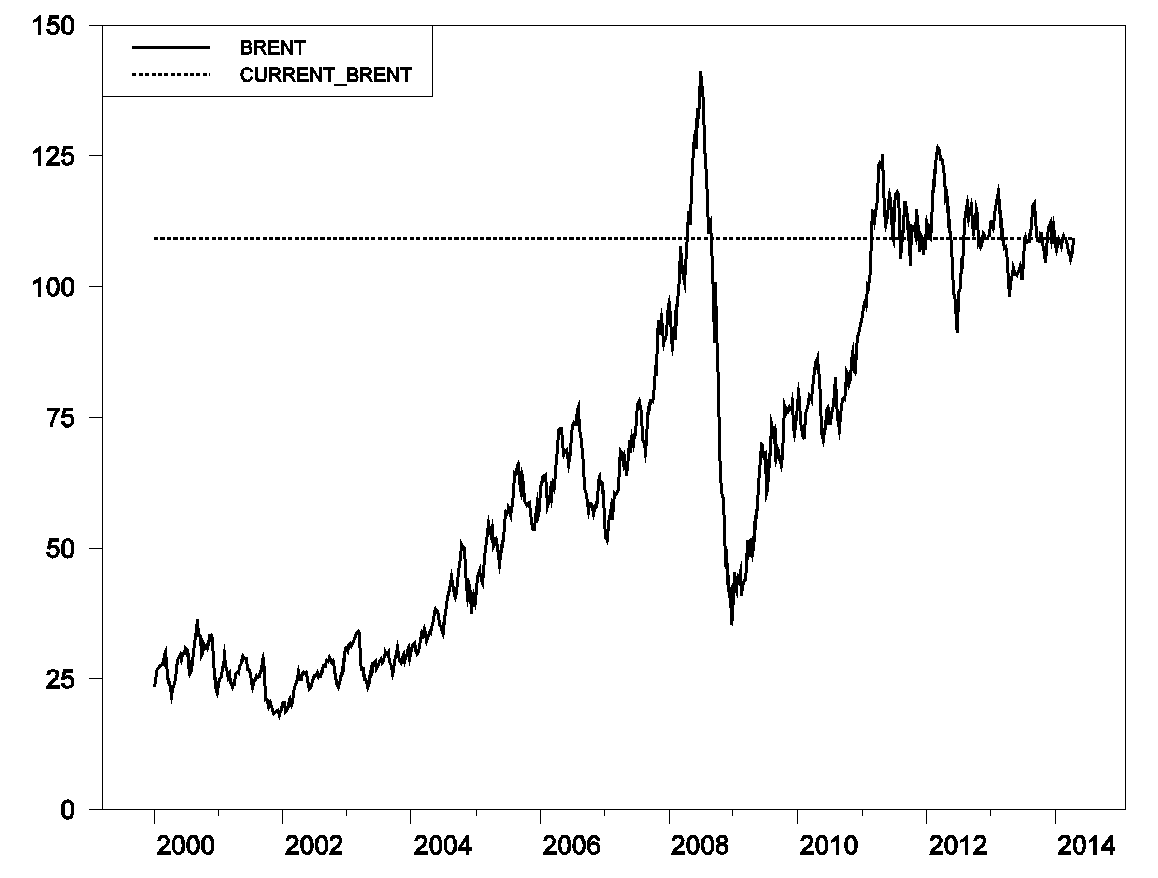
Today oil costs around 4-times of the late 1990! (wikipedia) Since the end of 1999 the price of oil jumped from around $25 to around $100 - plus 300%, while the US stock market (S&P 500) gained anemic 30%. It seems that the oil market ignores the sluggish global economy since the begin of this century. It also ignores the rise of the US as a major oil producer which is lifting the global oil production thanks to new technologies like fracking & deep sea exploration.
The discrepancy between high oil prices and the economy signals that the oil market ignores the economical fundamentals - neither the supply of oil nor the demand for this commodity explain the oil price explosion in this century. Instead the price of oil has been ruled by geopolitics.
Oil is traded on financial markets like stocks and bonds. Many hedge funds and other speculators are buying oil futures, which represent the energy prices. Since the early years of this century they have been pumping many billions of dollars into the oil market in the hope of further price gains. Hence the oil price reflects expectations rather than the real supply and demand.
Today the speculators focus on the Ukraine conflict. Russia is one of the world`s biggest oil producers. Speculation that sanctions against Russia - and the worst case scenario of a war in this region - will interrupt the global supply of oil are keeping the price of oil north of $100. Today the future for Brent Crude - the type of oil which is used globally - costs $108, WTI (West Texas Intermediate), the future for US oil, fluctuates around $100.
The Ukraine conflict is just the newest of the political issues which are keeping oil expensive. Since the year 2004 oil prices have been agitated by continuous speculation about conflicts in the Middle East, the so-called Middle East tensions. Wars and unrest in Iraq, Libya, Syria, Egypt and other countries of this fragile region plus the ongoing conflict with the Iran about its nuclear facilities all induced speculation that the global oil supply could be endangered. Hence the price of oil has a geopolitical risk premium.
The high price of oil is a huge incentive to produce more of this precious commodity as you can see in the US. Other countries like China also are beginning with fracking to reduce the dependence from imported energy. Expensive oil also curbs the demand: People drive less, use fuel-saving cars and other energy-efficient machines (demand destruction). They also switch to alternative energy sources like natural gas, wind & solar energy. Both trends lead to an over supply which you can see in the US where the stockpiles reached a record high.
But the price of oil is still floating around $100. It seems that the oil market is functioning like a hot air balloon. A steady flow of geopolitical news (Ukraine, Middle East) has been heating the speculation on upcoming supply problems and is keeping the price of oil high like a balloon in the air.