Saturday, March 21, 2015

Books: Some Comments On Atlas Shrugged By Ayn Rand


(Drivebycuriosity) -  Better late than never. Finally I finished the novel  "Atlas Shrugged" by Ayn Rand (amazon). The 1,188 pages are a challenge but the book is at least worth browsing it. "Atlas", published 1957, is called dystopian science fiction because Rand described a sinister fantasy world (driveby). But contrary to the mainstream of dystopian authors Rand was basically very optimistic. She beliefed in technology - and entrepreneurs were her heroes. But she was very pessimistic for a world controlled by politicians, bureaucrats and for socialist experiments, maybe influenced by her childhood in communist Russia.

I see "Atlas" as an economic textbook in the shape of a novel. Rand described dramatically how a government destroys the economy, existences and lifes when the politicians replace self interest and the profit motive by "needs" and "social progressive ideas" and swap entrepeneurs by bureaucrats. Rand predicted (somewhat) the breakdown of the then powerful Soviet Union (wikipedia) and today´s mess in Greece.


Here a defining paragraph: "They ran first. They deserted us, one after another……Our plan? We put into practice this noble historical precept: From each according to his ability, to each acceding to his need. Everybody in the company, from charwoman to president, received the same salary - the barest minimum necessary. Twice a year, we all gathered in a mass meeting, where every person presented his claim for what we believed to be his needs. We voted on every claim, and the will of the majority established every person`s need and every person´s ability. The income of the factory was diverted accordingly. Rewards were based on need, and the penalties on ability. Those whose needs were voted to be the greatest, received the most. Those who had not produced as much as the vote said they could, were fined and had to pay the fines by working overtime without pay. That was our plan. it was based on the principle of selfless. It required men to be motivated, not by personal gain, but by love for their brothers."


                                                      Rearden Steel

A part of Rand´s technological predictions and speculation are becoming true as well. Today global oil procuction is rising thanks to US entrepreneurs who are using new technologies to tap Shale oil as described in "Atlas". Another prediction could soon become reality: The "Economist" reports that scientists and engineers are developing "an alloy of iron and aluminium which is as good as titanium, at a tenth of the cost" (economist) - exactly as described in "Atlas" ("Rearden Steel").

Rand also drew a precise picture of the mainstream media (newspapers) who focus on negative news and pessismistic "experts" and polemize against corporations & enterpreneurs (today for instance New York Times, New Yorker, Atlantic Magazine, Süddeutsche Zeitung).

I wasn`t much entertained by the plot. Rand painted with a thick brush, many actions were overdramatic for my taste and I couldn´t really believe in the characters. The book would have gained much if a qualified editor would have if it condensed down to around 300 pages. Anyway,  I enjoyed the novel as a satire and an important philosophical work. "Atlas" is certainly an antipode to Karl Marx, maybe the "Anti-Das Kapital". If more poeple would read "Atlas" and learn from Ayn Rand, the world would be a better place.


Friday, March 20, 2015

Economy: Why Do Liberals Love Short Sellers?


(Drivebycuriosity) - This week the "New Yorker" has a hymn on short sellers ("In praise of short sellers" newyorker). These people are betting on falling stock prices. They borrow stocks from a broker and sell the shares immediately (going short or shorting) in the hope that stock prices will fall and then they could buy back these stocks for much less.

The laudation is interesting. The "New Yorker" is a left-leaning magazine. They usually write against capitalism, business and corporates. Last year the liberal magazine attacked Amazon.com, claiming the company is a monopoly and is bad for the book culture (driveby).

This time the "New Yorker" celebrates  Whitney Tilson. The hedge fund manager appeared recently on TV and accused "Lumber Liquidators", specialty retailer of hardwood flooring, that their products are unsafe because of unlawful high formaldehyde levels. The media attack worked form him, the stock tanked around 50% - a huge gain for the short seller.

Later "Lumber Liquidators" defended themselves saying "that they are the victim of a small group of short-selling investors who are working together". They also claim that the allegations are based on improper and "deconstructive" testing methods (seekingalpha   lumber). Even the "New Yorker" concedes that "short sellers are often wrong, and that may yet prove to be the case with Lumber Liquidators" (newyorker). But the stock stays down,  as usual the defamation sticks.


                       Ackman`s Crusade

I have written before about short sellers who manipulate stock prices by spreading negative gossips & rumors (here   here). Poster boy of the short seller crowd - and also clebrated in this "New Yorker" article - is William A. Ackman. The hedge fund billionaire  and CEO of the hedge fund Pershing Square Capital Management is betting big against Herbalife, a producer and seller of nutritional supplements traded on Wall Street. 

In December 2012 Ackman revealed that he had shorted massively stocks of Herbalife and then started bad-mouthing the firm. To bring the stock down Ackman did not just use his huge reputation as a billionaire hedge fund manager - there is cult around short sellers like Ackman -: "His team has helped organize protests, news conferences and letter-writing campaigns in California, Nevada, Connecticut, New York and Illinois, against his victim - although several of the people who signed the letters to state and federal officials say they do not remember sending them" wrote the New York Times (nytimes). He also pulled the political puppet strings and got support from leading politicians.

Ackman`s manipulations seem to fire back. Recently started a federal probe into the possible manipulation of Herbalife stocks by Ackman (businessinsider    social). The Wall Street Journal reported that people connected to Ackman and his hedge fund, Pershing Square, have been interviewed by government officials. At least one person – a hair stylist from Hartford apparently tied to a letter-writing campaign intended to discredit Herbalife – was subpoenaed late last month to appear before a federal grand jury in New York.

All short sellers benefit from falling stock prices. Thus they have a natural interest that the business of the shorted company fails. Ackman openly goes for a bankrupt of Herbalife and he uses his power to bring the stock down. In the James Bond movie "Casino Royale" the villain, named "Le Chiffre", shorted stocks of an airline and then ordered an assassin to bomb a valuable new plane in order to destroy the whole company. This is just fiction, but gives an idea how short sellers could work. Even when short sellers do nothing illegal they can inflict a lot harm by spreading  rumors and allegations which can ruin the reputation of a company and thus irritate customers, creditors, investors and employes and so inflict damage on the company.


                          Feral Hogs

Sometimes short selling gets out of control and does considerable damage to the society. Shortly after the bankruptcy of Lehman Brothers, which brought huge gains for short sellers, groups of short sellers tried to repeat their success.  In the months after Lehman´s fall herds of them - hedge funds and their followers - attacked everyone who seemed vulnerable - almost any bank had to be saved. Federal Reserve member Richard Fisher (Dallas Fed President) described this species as " big money" that "does organize itself somewhat like feral hogs. If they detect a weakness or a bad scent, they go after it."(marketwatch).

In the panic of late 2008 and early 2009 - as the stock prices were already down and still falling -, herds of short sellers massively dumped stocks and sent stock prices further down. Massive shorting enhanced the fall of the stock market, this created panic and downward spirals for almost any stock on the market. The crash, exaggerated by short selling, led to ridiculous undervalued stocks in spring 2009. This under valuation made the massive rally since then (plus 190% plus) possible. The stock market crash was at least amplified by excessive short selling that paralyzed the whole economy. Companies ceased investing & hiring, the recession was on the brink to turn into a disaster like the great depression of the 1930s.


It is remarkable that liberal "The New Yorker" supports short sellers. Maybe their comradeship  is part of their ongoing anti-capitalism crusade.


Thursday, March 19, 2015

Economy: Oil Price - Cue Ball Of The Speculation

(Drivebycuriosity) - Yesterday the oil market showed again that it doesn`t care about the fundamentals. The oil price is just a cue ball of the speculators - at least in the short run.

In the morning we learned that the already record high US inventories climbed another 9.822 million barrels; they are now 37% above the historical average for this time of the year - another proof of the growing oil glut (bespoke). There is also a deal with Iran in the making which could lift the sanctions and raise the supply from this important producer (geopolitics).

Nevertheless the oil price (Brent Crude) jumped 6% yesterday - ignoring the fundamentals. According to the media hedge funds and other speculators raised their oil bets because in the afternoon the US Federal Reserve gave a dovish outlook and signaled that they will raise interest rates slower than expected (cnbc). The US stock market responded with a gain of 1.2% (S&P 500). Related to the moderate stock market reaction the oil price jumped 5-times.

How can the oil price rise so strong when the oversupply is growing? Oil is represented by futures (financial contracts for delivering oil at a date in the future). When the media report about oil prices they usally refer to the future for Brent Crude, the future for international traded oil, or the WTI (the American type of oil). Theses future are traded on financial markets and behave like stocks and other traded assests. In the short run the future prices reflect the behavior of traders on financial markets, mostly hedge funds and other speculators. Therefore the oil price is shaped by the bets on the financial markets.

From 2009 till last autumn hedge funds, pension funds and other huge speculators have been betting billions of dollar on rising oil prices fueled by speculation on geopolitically induced supply disruptions (Iran Conflict, wars in Iraq, Syria and other countries  driveby). These bets kept oil expensive (above $100) even that the oil supply was already rising thanks to the climbing US production and return of oil suppy from Iraq. Last autumn the oil price bubble burst because the oversupply couldn`t be ignored anymore.

Today oil prices gave parts of their gains back, in the moment of writing Brent Crude down 3%, WTI minus 2.7%. Another proof that the price of oil is a cue ball of the speculation.


Wednesday, March 18, 2015

Contemporary Art: Photorealistic Paintings @ Stricoff Fine Art, New York


(Drivebycuriosity) - Being an amateur photographer I am fascinated by photorealistic paintings. These images often look so intense and powerful. It seems that the painter has more control over his creations than a photographer. Anyway, these paintings are an inspiration for my further works as photographer.

The gallery Stricoff Fine Art in New York`s classy Chelsea district (564 W. 25th Street stricoff) shows works by Jeff Cohen and others. Above you can see Cohen`s  "New York City Subway Platform" (2015, oil on Panel).

Cohen`s painting above is called "Night Colors at E 23rd Street" (2014, oil on Panel).


Above another Cohen:  "New Orleans Night Puddle" (2014, oil on Pannel)


Above a painting by David Kessler named "Luminuous Shimmer" (acrylic on aluminum).


Enjoy!


Tuesday, March 17, 2015

Economy: Why The Supposed China Collapse Is Nonsense

(Drivebycuriosity) - It seems that China bashing is en vogue. For years China pessimists like New York Times columnist Paul Krugman, the hedge fund manager Jim Chanos and others have been banging the China crash drum (driveby). Now the magazine "Fortune" has another anti-China rant. The political science professor Minxin Pei predicts that China´s economy will collapse (fortune). The politics expert complains about  "unhealthy combination of excessive debt, overcapacity, and a lack of new sources of growth".

I think the allegation that there is "a lack of new sources of growth" is unfounded:

1. The most important source of growth is the secular catching-up process which is fueled by the still extreme income & wealth differences to the US and other Western nation values. This adaption process has been driving Chinese growth in the recent decades and there is no reason why it shouldn´t continue in the coming year.

The huge country is rapidly transforming into a consumer economy like the U.S. and other modern countries. Many peasants are moving to the huge metropolitan centers which are spread all over the huge country to lift their standard of living. This creates a fast rising affluent middle class, giving consumer spending a boost as the strong retail sales (growth rates around 11%) demonstrate.

China´s growth is also boosted by the technological progress and advances of Internet, automatization of industrial production and 3D-printing. These developments raise efficiency and  productivity of China´s economy as success stories like Alibaba and Baidu demonstrate.

2. Another source of growth are the ongoing reforms that started in 2013 (china). Last year Beijing announced the liberation of stock trading between Hong Kong and mainland China, softened the one-child policy, encouraged migration to bigger cities (with a higher productivity, announced more investments into airports, railways and other infrastructure and more.

3. China`s central bank is responding to the moderately slowing economy (from double digit growth rates to plus 7.4% in the last year) and sinking inflation rates (thanks to cheaper commodities) and is lowering interest rates & restrictions for the banks.

4. China´s economy gets a lot of tailwinds from the drop of oil and other commodity prices (around 50%). Inflation rates are falling, consumers have more  money to spend and industries (especially the transport sector) have less costs.


                                      Lack Of Economic Understanding

I think that Minxin Pei overemphasizes the debts, as many China bashers do. Imagine you have a debt of $50,000 which is backed by a stock portfolio value $100,000 (collateral). Nothing to worry. If your stocks fall 60% ( the value of the collateral drops below the debt line) you are in trouble. If your portfolio then recovers and claims above $100,000 your finances are sound again. Looking on the debt alone doesn´t make sense. Important is the relation between debt and assets (collateral) - and China has a lot of assets.

I think a dynamic developing country has to be financed by loans and has to expand her capacities to facilitate further growth. I reckon that China will continue her dynamic growth in the coming years  and  therefore will find uses for the so-called overcapacity and justify her debts.

Minxin Pei`s rant seems to me ignorant and shows his lack of economic understanding. Maybe he confused China with Greece or Argentina.

Monday, March 16, 2015

Social Networks: Will Facebook Become As Irrelevant As The Vatican?

(Drivebycuriosity) - What do Facebook and the government of of China have in common?  Both practice censorship. The government in Beijing shut down website pages because of alleged porn on these sites. Facebook does the same.

Jerry Saltz, art critic for the New York Magazine, got suspended from Facebook because the ubiquitous nude art pics on his page conflicted with the anti-nudity policy of the company (theverge). In France a Facebook user went to court because the company had blocked his account. The plaintiff had posted an image of a 19th-century painting depicting a vagina  (a photo of Gustave Courbet's L’Origne du Monde/The Origin of the World) (world-arts).

Both issues got a lot of attention in the media. Facebook wasn´t amused. Zuckerberg & Co. responded this weekend with a "clarification" of their anti-nudity rules. They declared they will "allow photographs of paintings, sculptures, and other art that depicts nude figures." But they will still restrict photos of "female breasts if they include the nipple" but will make exceptions for "women actively engaged in breastfeeding or showing breasts with post-mastectomy scarring." (nbcnews)


                                                    Scared By Nipples?


What is wrong with nipples? Facebook´s response looks hypocrite and cowardice to me. Ok, people post on their site and it is free. But the company claims to be a social network. I think Facebook`s anti-nudity policy conflicts with the freedom of speech and makes the service boring and sterile.

And there is an alternative: Twitter. They allow democracy and freedom of speech. Twitter doesn`t have problems with sexual explicit content, you could research it there on your own risk. And they don´t gag Jerry Saltz and his kind. Art is a version of free speech and was always provocative, it cannot function when it is gagged.

Twitter is now a much more vibrant place than Facebook and more open. Anybody can make his voice heard, and you can find a lot of opinions - even some which might no please the censors. Contrary to them Zuckerberg & Co. seems to become a place where Grandmas communicate with their grandchildren.

I think if Facebook doesn`t open up it will freeze over the time. The service could become as irrelevant as the Vatican. The Pop is still heard but his power has disappeared.

PS For illustration I used the painting "Bathseba in the bath" (1617) by the Dutch painter Cornelis van Harlem which I found at Berlin`s Gemäldegalerie.

Sunday, March 15, 2015

Contemporary Art: Empire of the Senseless @ Gallery Friedman Benda, New York


(Drivebycuriosity) - I like to explore contemporary art and to get surprised and entertained. Yesterday I visited the gallery Friedman Benda, one of the classy art dealers in Chelsea (515 W 26th Street New York friedman). The place has an exhibition called "Kathy Acker Empire of the Senseless" (through March 28).

The title of the show refers to the Punk author Kathy Acker and her 1988 novel "Empire of the Senseless" (exhibitions). The curators describe  this book as a "dark, grotesquely candid, screaming requiem to the romanticism of the patriarchy". The gallery invited six artists "to use painting to reflect on their unique explorations of reality".

Anyway. I enjoyed the selection, senseless or not. This posts starts with Natalie Frank`s painting "Women in Interior" (2015, Oil canvas, 60 x 72 inches, 152.4 x 182.9 cm).
I indulge into the warm colors and into the inviting character of the composition.


Unfortunately the gallery didn`t care to tag the paintings. Even the website wasn`t very helpful. But the painting above also belongs to Natalie Frank.


This is another work by Natalie Frank - certainly not the usual chicken wings.


This is a painting by the Swedish artist Kristina Jansson I suppose.


Above you can see more works by Kristina Jansson (segments clockwise).


Kristina Jansson named the work above "Cut 2" (2015, Oil on canvas, 100.39 x 65.75 inches, 255 x 167 cm)


                                Cold Heat


The lady before the green window (?) is a work by the Swedish artist Sara Vide‐Ericson (saravide). The painting is titled "The Obvious" (Oil on canvas, 130x160 cm, 2014).


The painting above is called "Cold Heat", again by Sara Vide‐Ericson (Oil on canvas, 130x160 cm, 2014).


Above you can see Sara Vide‐Ericson`s "The Rapture" (2014,
Oil on canvas, 63 x 47 inches, 160 x 120 cm).


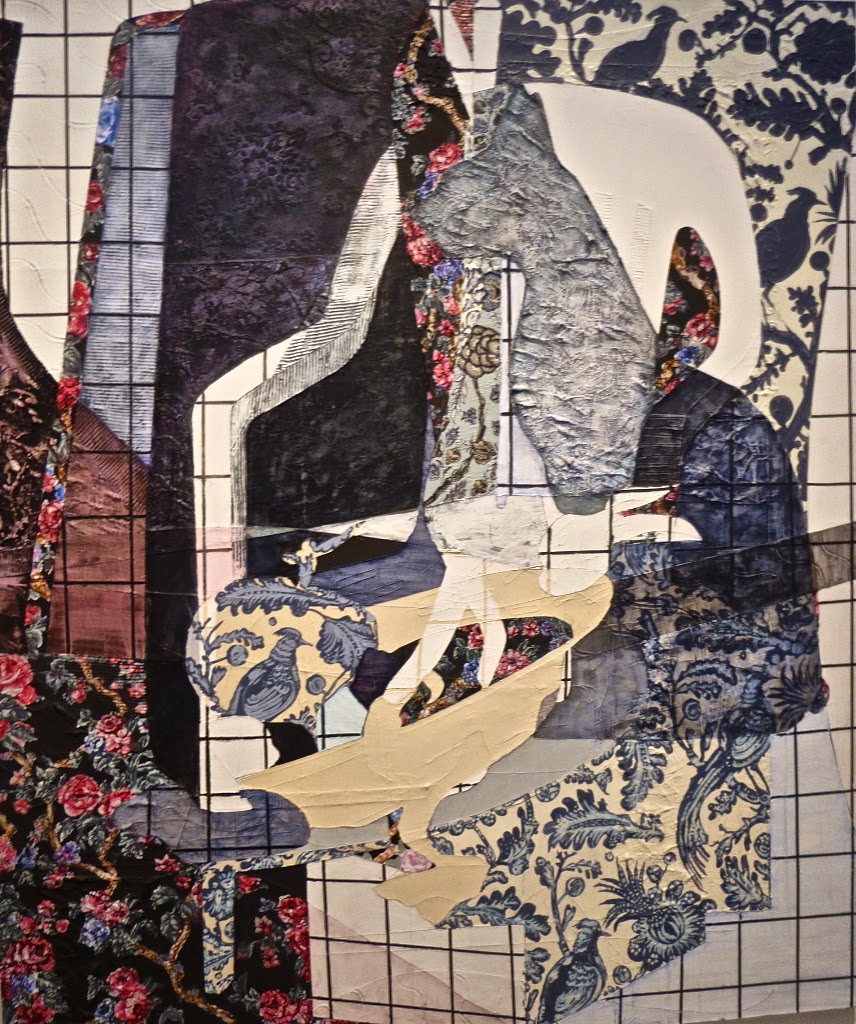
This one is "Appliqué" by Francesca DiMattio 
(2014
, Oil, acrylic and collage on canvas
, 90 x 76 inches
, 228.6 x 193 cm).


                             Female Answer


I guess that the 3 works above are all created by the German artist Rosa Loy. Her style looks like the female answer to Neo Rauch, another German (in December I reported about his show @ David Zwirner driveby).


Rosa Loy named her composition "Bearbeitung (Processing)" ( 2015, Casein on canvas, 59 x 39.5 inches, 150 x 100 cm).


Enjoy!


PS. The pictures are taken with a point-and-shoot camera (Panasonic Lumix DMC-SZ7) which doesn`t get the images perfectly. If you go to the gallery you will get a much better impression.