Tuesday, May 13, 2025

Economics: Why Inflation Is Trending Down


(Drivebycuriosity) - Trade war or not. Inflation is trending down. Today we learned that the US inflation rate sank to 2.3 y-o-y%, continuing the retreat of the recent months (cnbc ). I did expect that.


                         Helicopter Money

As I wrote in so many blog posts: The high inflation of the recent years was caused by a deluge of money in the years 2020 & 2021, when the Biden administration flooded the economy with stimulus checks in the value of trillions of dollars to fight the Covid19 recession (American Rescue Plan). The Federal Reserve financed the government cheques by massive bond purchases (Quantitative Easing known as QE1, QE2 & QE3).  

The government money landed directly on the bank accounts of the Americans, blowing up the money supply M2 (bank notes & coins & deposits at banks). Milton Friedman described this as helicopter money (cato ).

As a result in the years 2020 & 2021 the US money supply M2, the engine of the inflation, jumped  40%. The money deluge met a constrained supply of goods & services partly - because of Covid19. "Inflation is caused by too much money chasing too few goods and services", taught Milton Friedman.


                        Causal connection

The causal connection between money and inflation is known since the 16th century at least! Nicolaus Copernicus described already in the year 1522 how "too much money" causes inflation. Copernicus` "quantity theory of money" is based on observations: 

Early in the 16th century Spain conquered today`s Latin America and looted the silver stocks. The Spaniards send the precious metal to Europe where is was printed into coins and used as money.

As a result the European money supply jumped, meeting a restrained supply of goods (agriculture, hand works) &  services. The flood of money raised suddenly the demand for scarce goods & services and caused a jump of the price level. The lessons from 17th century inflation became the basis for the famous quantity theory, which relates money (and its growth rate) directly with the price level (and its growth rate, the inflation).

Elaborated studies by Milton Friedman, Karl Brunner, Allan Meltzer and many other economists (known as Monetarists) described already in the 1960s and 70s how and why the inflation rate follows the growth rate of money with a long time lag (often 12 to 18 months).


( source)

                      The Pull Of The Money 

Fortunately the money flood ended already in 2022 and the money supply shrank for a while. Since October 2023 the money volume is growing again, but only moderately. In March M2 grew just 4.1% (ycharts ).

I am aware that the tariff hikes will raise many prices in the US. But the slow monetary growth is constraining the general price level. The price of oil is under pressure and US home price increases, that contribute about 50% to the measured inflation rate (shelter costs), are now decelerating at a rapid clip ( bilello.blog). 


Sunday, May 11, 2025

Art Market: Tidbits From Spring Auctions 2025 @ Christie`s


(Drivebycuriosity) - It`s May again and the world`s largest auction houses have their annual Spring fall auctions in Manhattan. This post focuses on the auction galleries @ Christie`s ( christies). As usual quality & quantity of the displayed art works was overwhelming and admission is free. I display here just my favorites, a very subjective selection as usual.


I happy to spot Neo Rauch`s surreal triptych "Para". The artist, born in 1960, grew up in the communist Eastern Germany, influenced by the so-called socialist realism, a style of realistic art that was developed in the Soviet Union, and studied figurative painting (artinamerica). Rauch mixes realism with fantasy and also plays surrealist games on canvas. According to Wikipedia his "paintings mine the intersection of his personal history with the politics of industrial alienation. His work reflects the influence of socialist realism, and owes a debt to Surrealists Giorgio de Chirico and René Magritte" (wikipedia).


Above follows Mark Tansey, another favorite of mine. The painting is called "Study for´TheEnunciation`". I admire how he mixes reality with fiction and plays surrealist games on canvas.


There were 2 works by Hernan Bas, who`s paintings I often see at the auction galleries. The images above are called "The Giant (Grooming)" & "The Hideout".


Georg Baselitz also belongs to the gallery & auction standards, above his "Strandbild #9".


                             Red Hot Sex


Cecily Brown likes to hide some red hot sex in her paintings, above her "Bedtime story". A while ago I saw a Cecily Brown show @ Paula Cooper gallery (driveby)


Above more stars of the female art scene: Marlene Dumas`"Miss January" & Jenny Saville`s "Componimento inculto".


Above "Flicker" by Sarah Sze; "Sad Vase" by Julian Schnabel; "A short walk" by Fairfield Porter & "Cascade" by Hans Hofmann.


Philip Pearlstein specialized in women who were not exactly fashion models. Above his "Model with Horn Chair". The artist was represented by Betty Cunningham gallery which is now sadly closed (here a Pearlstein show driveby).


Above some classics of modern art: Rothko´s "No 4 (Two Dominants) Orange, Plum, Black"; Warhol´s "Mao" & Christopher Wool`s "Untitled".


I believe I have seen Ives Klein`s "Venus d`Alexandrie (S 41)" already at other auction galleries. This work is number 51 from an edition of 300 plus. But anyway, isn´t she an eye cooking.


Wassily Kandinsky´s futurist "Ohne Titel (Dessin pour l`Almanach "Europa" 1925) looks like an algorithm for AI.


 I am fascinated by Rene Magritte´s "Le empire des lumières", painted 1949. The master created several variations of this 2 idea, two of them I spotted last November at Christie´s (driveby ).


Above another famous surrealist: Salvador Dali`s "Portrait of Mitzi Sigall".


One more Surrealist: Paul Devaux`s "Le jardin nocturne"


Franz von Stuck´s famous "Die Sünde" (The Sin).


There were of course plenty of impressionists, above Edouard Vuillard`s "Jean Laroche" & Henri Lebasque`s "Le gouter sur la terasse a Sainte-Maxime".


And last but not least 2 lovely ladies by Andre Lhote called "Femme nue en buste" & "La torse a`la chaise". 


To be continued


Tuesday, April 29, 2025

Books: The River At The Center Of The World: A Journey Up The Yangtze And Back In Chinese Time


(Drivebycuriosity) - I am fascinated by China, a huge country with more than 5,000 years culture. While Europe´s civilization disappeared after Rome´s collapse around the year 400 - followed by about 1,000 years of darkness -  China´s civilization continued and flourished. The Middle Kingdom invented book printing, porcelain, gun powder, iron casting, paper, the rudder, the wheelbarrow and - yes - the pasta (Beijing cuisine knows Spaghetti, dumplings and lots of other varieties of noodles). 

China´s history, culture & politics are influenced by the Yangtze, Asia´s longest river, stretching 3,964 miles (6,378 kilometers). Mao Zedong swam there 2 times together with his soldiers to demonstrate his strength.

Simon Winchester wrote a fascinating book about the majestic waterway:  "The River at the Center of the World: A Journey Up the Yangtze and Back in Chinese Time". The book is much more than just a travel report (amazon ). The author covers China´s history, the political, cultural and economic developments over the recent 200 years at least and he portraits sheer countless persons, who`s lives have been somewhat related with the river.


                         Brain & Muscles

The Yangtze stretches from the Himalayan highlands in the West to the Pacific in the East. "Some geographers and writers like to think of the river as a sort of waistline, a silk ribbon that cinches China quite decidedly into two. Above the waist are the brain and the heart and soul of China, a land that is home to the tall, pale-skinned, wheat eating, Mandarin-speaking, reclusive and conservative peoples who are the true heirs to their Middle Kingdom´s five thousand years of uninterrupted history. Below the river-waist, on the other hand, are the country´s muscles and sinews: the stocky, darker, more flamboyant, rice-eating people who speak in the furiously complicated coastal dialects". 

Winchester`s journey began at the river`s estuary at the China´s coast, close to Shanghai, then he went westward, using boats, busses and cars up to the sources of the river in Tibet. 

The author portraits Shanghai, his first stop, and claims "that Shanghai is soon going to occupy an exalted place in twenty-first century China  - and a position that maybe may be very much more exalted in China than that occupied by today`s Hong Kong". According to Winchester the Shanghainese "have a masonic solidarity about them, a grim determination, a ruthlessness that inspires fear and respect throughout all China. Now that they have been unshackled, they have a much greater potential - and many more friends and allies - than their country cousins in the south." He quotes his Chinese travel partner: "Who are the really smart Chinese in Hong Kong anyway? They are the Shanghainese businessmen who went there after the revolution".

                    The Rape of Nanjing

Further up the river, Winchester stopped at Nanjing. He reports about the Japanese bombing of the city in the 1930s and the horror her population had suffered. "Japanese soldiers treated the soldiers and civilians they had pinioned in Nanjing as animals, available for every act of barbarism and butchery it is possible to imagine. The Tokyo War Crimes Tribunal said later that 200,000 men were slaughtered, and 20,000 women raped" (page 158-165 in Kindle version).

Winchester traveled in the begin of his journey mostly on ships & boats, later - in the western mountains - he changed to buses and taxis. The bus rides in the western mountain valleys where often extremely adventurous, not only that the streets were dangerous - often very tight - and led over high cliffs. Sometimes the vehicles were on the brink of braking down and the traveler himself had to help the drivers to move the vehicle. 

In one case Winchester had to share the ride with aggressive members of a mountain tribe, who claimed to own the right to enter the bus. These people squeezed into an already overfilled bus and the foreigner had to suffer sitting between too many humans and a pig.


           A Cauldron Of Tortured Spray & Air

But Winchester got rewarded by fascinating landscapes, especially when the river cuts through the mountains. He was especially impressed by the "3 Gorges" - three adjacent and sequential gorges in the rocky hinterland of the People's Republic, spanning 193 miles (311 km).

He reports. "The rushing Yangtze became barely unimaginable. All these millions of tons of roaring water are suddenly squeezed between gigantic cliffs, are contorted by massive fallen stones and by jagged chunks of masonry, and they sluice and slice and slide and thunder down slopes so steep that the waters hurtles down ten, twenty, fifty feet in no more than a few hundred furious yards. In places like these the water is not so much water as a horrifying white foam - a cauldron of tortured spray and air and broken rock that is filled with the wreckage of battered whirlpools and distorted rapids and with huge voids of green and black, the whole maelstrom roaring, shrieking, bellowing with a cannonade of unstoppable anger and terror".

And he adds: "All these millions of tons of roaring water are suddenly squeezed between gigantic cliffs, are contorted by massive fallen stones and by jagged chunks of masonry, and they sluice and slice and slide and thunder down slopes so steep that the waters hurtle down ten, twenty, fifty feet in no more than a few hundred furious yards".


                         Vertical Drop

Unfortunately the neighbors of the Yangtze had been suffering frequently severe floods that caused the lives of millions, for geological and climatic reasons:

"China`s western side is universally high - an immense mélange of contorted geologies that involve the Himalayas, the Tibetan Plateau, and the great mountain ranges of Sichuan, Yunnan and Gansu. Her eastern side, on the other hand, is flat and alluvial and slides muddly and morosely down into the sea. The difference  in altitude between her western provinces and the sea is so vast - involving four and a half miles of vertical drop - and the trend of the slope  so unremitting that anything which falls onto her western side, be it snow, hail, torrential rain or the slow gray drizzle of a Wuhan afternoon, will roll naturally and inevitably down to the east".

To make things worse "China receives a very great deal of rain each year - far more, per square mile, than Europe or the Americas....nearly all of this precipitation falls in topographically chaotic west and the south of the country - the principal reason that rice is the crop of choice grown in the wet warm south, and the wheat the staple in the dry cool north. (The dividing line, the so-called wheat-rice line, almost precisely parallels the track of the Yangtze)"

The substantial and geographical concentrated rainfall is intensely seasonal - the summer monsoon dominates southwestern China´s weather system.. and the rain falls just when the summer sun begins warming tings up - including the snows and glaciers of China`s western mountains. These start to melt, and to produce their own torrents of eastbound water, at exactly the time the rains come... Every summer and all of a sudden, gigantic quantities of water begin to course down each of the tributary streams of China´s two main river systems (besides the Yangtze the Yellow River). In 1931 happened the Central China Flood and more than 140,000 people drowned, twenty-eight million people were affected.


                     Taming the Yangtze

It is not surprising that China decided to tame the Yangtze and build a huge dam at the 3 Gorges Dam (completed 2006, Winchester traveled long before). The author dedicates a full chapter (about 50 pages ) on this topic, where he describes the global history and pros and cons of dam building, the political controversies and international influences. 

He elaborates about the advantages like flood control, creating shipping passages and hydro power, and names the risks of dam breaks, that could kill hundred of thousands, and disadvantages, like the need to deport thousands of people and ruining landscapes. "It took engineers and politicians and military experts forty-nine years to choose the exact side for the dam! 


                  Xenophobe Bureaucrats

 During his journey Winchester had to struggle with  authoritarian politicians, xenophobe bureaucrats & cops, who did not like that a foreigner explores their country and tried to block his advance. But the foreign traveler benefited from the assistance of a Chinese woman who accompanied his journey and used her charm and stubbornness to deal with bureaucrats & the police force.

Winchester mentions the cultural and ethnic differences of this huge country and claims "that China´s Northerner don´t like rice, and they don´t like Southerners, and the Yangtze is as convenient a line as any to draw between them". According to "a Beijing friend" the Cantonese (Hong Kong Region people) -"rice eating monkeys" are ill regarded by just about all their brother Chinese. "They have performed economically so well merely and solely because of the benign invigilation of the British, who kept them cozy and secure and colonized for a century and a half".


            Building China`s Infrastructure

Many parts of the book dive into China´s history and Winchester portraits the role of English and other foreign companies in the building of China`s infrastructure - railways, canals - in the 19th and early 20th century. In the 19th century American & British corporations shipped on the Yangtze and they employed naval gunboats. They were patrolling, keeping the trade lanes open, protecting citizens and compradors alike from the strange irrationalities of Chinese warlords.

Winchester also criticizes a lot the communist dictatorship and how Beijing is suppressing ethnic minorities, especially the Tibetans.


                         Elemental Kind Of Sport

The book has many more tidbits. Like: "the Chinese had invented gun powder for use in fireworks, and yet had never thought for using it in war".

Mao loved to swim in rivers. The Chairman saw it as an elemental kind of sport, where man`s energy and wiles could be pitted against the brute strength of nature. "It was June 1956 when the Chairman embarked on his first swimming expedition on the Yangtze: he did so to pit himself, symbolically, against brute strengths of quite another variety". Swimming would also show that Mao was strong and fit and capable and fearless - all estimable qualities of leadership. And if nothing else it would reinforce both his and China´s undeniable uniqueness."

And I also learned that black tea (the Chinese call it red because of the color of the infusion; we call it black because if the color of the leaves) is nothing more than green tea that has undergone processing, heating and fermenting.


     Why Winchester Could Write This Book

Winchester was no average traveler. He graduated in geology, worked in Africa for a mining company, lived years in India & China and traveled the world as correspondent for "The Guardian" and other media. I learned a lot - not just about China - and I enjoyed Winchester`s elegant style, his precise comments, his analytics and his dry humor. The book is a real gem.


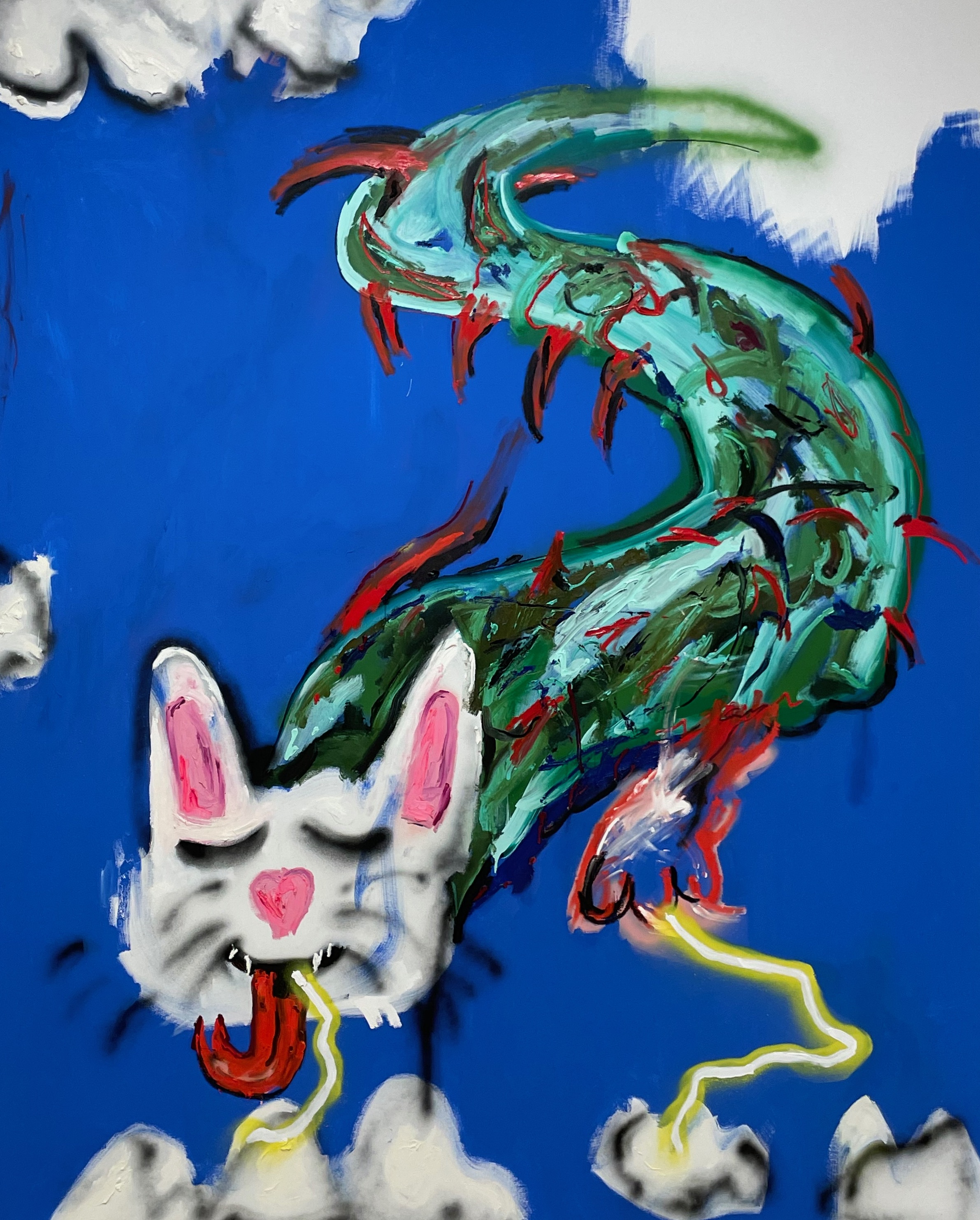
Contemporary Art: Funny Dragons & More @ Pace New York


 (Drivebycuriosity) - I discovered the weird art of Robert Nava @ Pace Gallery in London (driveby ). 


I liked the humor of the artist and was impressed by the power of his large images. Recently I spotted a Nava show @ gallery Pace`s dependance in Manhattan ( pacegallery). The expedition is called "After Hours". On top of this post you can see "Anger Management" followed by "Thunder Chase Dragon" & "Protecting My House".


Above this paragraph follow "Dream Fade Bunnies";"BLISS Daydream Dragon" & "Airborn Shark".


To be continued


Books: Typhoon And Other Stories By Joseph Conrad


 (Drivebycuriosity) - I am impressed by Joseph Conrad and I also envy him. He was born and raised in Poland and spent his youth on ships. Conrad learned English later in his life and became eventually one of the most accomplished writers in the language of Shakespeare - admired for his style. Me, born in Germany, still struggling with English & American, even though there are so many Germanic parts.

The anthology "Typhoon And Other Stories" shows Conrad´s mastership (134 pages amazon). I indulged in the finesse of his tales. Unfortunately I did not find the plots very plausible and disliked some of the leadingn characters. In one story a pretty and nice girl is falling for a man, who is described as a bully, a monster and a creep. But that might be purpose because Conrad is known as  

There is one exception, the name giving novella "Typhoon". It follows the captain of a steamship and his crew, who are transporting a group of local workers along the coast of South China. The captain stubbornly steers his ship into as typhoon to spare the costs and time to avoid the storm. The descriptions of the massive cyclone, the violent ocean and the mess on the ship are breathtaking.

Here an excerpt: "It was something formidable and swift, like the sudden smashing of a vial of wrath. It seemed to explode all round the ship with an overpowering concussion and a rush of great waters, as if an immense dam had been blown up to windward". 

"Typhoon" alone justifies the 99 cents that the Kindle version costs in the moment of writing.

Monday, April 28, 2025

Contemporary Art: Forged In Local Minerals - Kylie Manning @ Pace New York


(Drivebycuriosity) - Do you like abstracts? At Pace in Manhattan`s Chelsea district I spotted the powerful paintings by Kylie Manning (pacegallery ). The show was called "There is something that stays".


According to the press release, the artist, who has lived and worked in New York for the last 20 years, presented paintings "forged in local minerals—tourmaline, calcite, and quartz—that pulse with the energy of the city and its people". But let the images speak for themselves.


To be continued

Thursday, April 24, 2025

Economics: Should Federal Reserve Chair Powell Stay In Office?


(Drivebycuriosity) -
Jerome Powell is in the headlines these days. The Chairman of the Federal Reserve tries to fight inflation. But Powell declared in public that he understands little about inflation ( image above source).

Powell neglects - maybe he doesn`t understand - that the high inflation of the recent years was caused by a deluge of money. In his 2023 Jackson Hole speech he stated: "The ongoing episode of high inflation initially emerged from a collision between very strong demand and pandemic-constrained supply" ( federalreserve). He added: "it was clear that bringing down inflation would depend on both the unwinding of the unprecedented pandemic-related demand and supply distortions and on our tightening of monetary policy, which would slow the growth of aggregate demand, allowing supply time to catch up". Powell talks a lot about "aggregate demand", whatever that means, there is no mentioning of "money".  

 And in 2024 Powell declared: "High rates of inflation were a global phenomenon, reflecting common experiences: rapid increases in the demand for goods, strained supply chains, tight labor markets, and sharp hikes in commodity prices" ( federalreserve). What about money? Apparently the leader of the American monetary authority does not care about money.

                      The Deluge

Powell ignores that in 2020 & 2021 the Biden government flooded the economy with stimulus checks in the value of trillions of dollars to fight the Covid19 recession (American Rescue Plan). The government checks got financed with massive bond purchases by the Federal Reserve (Quantitative Easing known as QE1,QE2 & QE3).

The government money landed directly on the bank accounts of the Americans, blowing up the money volume M2 (bank notes & coins & deposits at banks). Milton Friedman described this as helicopter money (cato ). As a result in 2021 & 2022 the US money supply M2, the engine of the inflation, jumped 40%. So the price level inevitably had to jump also and the inflation rate (first derivation) went up.


                         Causal Relationship

The causal relationship between the money supply and inflation was already recognized by Nicolaus Copernicus! The astronomer explained in the year 1517 why "too much money" causes inflation. Copernicus` "quantity theory of money" is based on observations: Early in the 16th century Spain conquered today`s Latin America and looted the silver stocks. The Spaniards send the precious metal to Europe where it was printed into coins and used as money.

As a result the European money supply jumped, but the supply of goods & services did not change much. The flood of money raised suddenly the demand for scarce goods & services and caused a jump of the price level.

Elaborated studies by Milton Friedman, Karl Brunner, Allan Meltzer and many other economists (known as Monetarists) confirmed Copernicus & their quantity theory of money. They described in the 1960s elaborately how and why the inflation rate follows the growth rate of money with a time lag (causal connection).


 ( source)

The recent monetary deluge ended 2 years ago. After a temporary decline, the money supply started to grow again, but modestly. In March the US money supply advanced just about 4% y-o-y (below the long term growth trend of 6% scottgrannis) and the inflation rate is falling and approaching the unofficial Fed target of 2%. But I could not find the word "money" in any of Powell´s speeches and statements.

It turns out that Powell is economic illiterate and ignorant of history. The US monetary authority deserves a better Chairman.